Freda: Good morning. This is Freda Liu. It’s Raise Your Game. Today, we have Sheila Singam from Human Equation, and Rayhaana Omar, who is a radio presenter for Radio Islam in South Africa but is based in Malaysia. In our series, we’re going to be meeting the last Friday of every month, but it’s around “Tools for Transformation: Taking Charge of Your Results”.
So, you know, sometimes you feel you’re stuck in a rut and life is passing you by. Do you often ask yourself, “Why is this happening to me?” or look back at your past and find it’s holding you back from getting what you want? So we’re going to go through, you know, some of these tools that have helped people. And today’s particular topic is “Operating at Cause Instead of Effect”. And so that got me thinking. So maybe, you know, you can just start off talking about these tools for transformation that we’ll be discussing on a monthly basis, Sheila?
Sheila: Okay.
Freda: Welcome back.
Sheila: Thank you, Freda. Nice to be here again. Tools for Transformation is about a series of tools that people can use – very practical tools to really change the way they feel, change the way they operate, and get into the empowering states that they want to be in; adopt some empowering beliefs that are going to propel them forward to achieve what they want in life; and, you know, how to set really powerful, well-formed outcomes that will actually become a reality.
Freda: And I know what we’re discussing here is around the basis of Neuro-Linguistic Programming (NLP) and also coaching, but sometimes the word “NLP” scares people away. So, until you see it come to practical use, then people understand it better.
Sheila: Yeah, I’ve had that experience because I use it in my corporate training. I do a lot of corporate training, and I move away from using the tools of NLP because sometimes people get very confused and say, “But that’s a therapy-based modality, you know?” So what I’ve done is taken it and extrapolated it into corporate use, and I’ve just got such amazing results from people at my training who say, “Wow, this is such powerful stuff. What is it?” And I will say, “Well, it’s basically NLP.” “But I thought that was just to clear people’s minds and all that.” I said, “Well, that’s the perception people have, but there’s so much more that you can do with it.”
Freda: Okay, so today’s topic is to operate at cause versus operate at effect. What it means, and some examples.
Sheila: Okay. To operate at cause is to actually take responsibility for achieving what you want in life. It’s taking responsibility to manage the way you feel. It’s taking responsibility for the achievements that you want in your life. Okay. People who operate at cause are the people who see life as a series of opportunities, and seize those opportunities and make the most out of them, and look at what they can learn from the adversities that happen in their life, as opposed to having the victim mentality, right?
People who operate at effect have this very victim mentality: “Oh, this happened to me. Why me? I’m a product of my past. See what my parents did, my teachers did, and this is why I cannot go further in life.” So these are people who operate at effect.
Freda: Okay. Now, okay, all right. Some examples, perhaps?
Sheila: Okay. An example of someone who operates at cause is someone who… Okay, let’s say a person has been abused as a child, whether it’s physically or sexually abused. A person who operates at effect will carry all of that, will go through life blaming their parents for not protecting them or blaming the perpetrator, and holding on to a whole bunch of negative emotions and negative beliefs because they say, “You know, I am the product of what happened to me, and see – look at me, poor me,” yeah?
And people who operate at cause could be a person who went through the same thing but decided, at some point in their life, to say, “You know what? That doesn’t define who I am. That doesn’t make me who I am. I can be better than that. I can let all of that go, and I can move forward to achieve what I want.”
Freda: I’m thinking of Oprah Winfrey.
Sheila: Absolutely! Now, there’s a woman whose life is totally at cause, not only for herself, but she’s causing things in the lives of others as well.
Freda: Okay. So why is it important to operate 100% at cause, 100% of the time?
Sheila: No, I tell people this and they say that that’s impossible. Okay. And I say, “Yeah, it might be.” Mm-hmm. Because even I, myself, occasionally… I mean, I’m not operating 100% at cause all the time. Yeah. I sometimes yell at the fellow who cuts into my path when I’m driving.
Freda: Humans!
Sheila: Yeah, but it’s like… It’s that, okay, pulling yourself back and saying, “Now, why am I doing this? Why am I reacting? Why am I giving the other person power over my life?” Whether it’s in an office situation or a personal relationship, the minute somebody begins to affect you negatively and you allow them, then you are operating at effect. Because really, Freda, if you were to say to me, “Sheila, you’re making me very angry,” I would come back to you and say, “Freda, I could make you a cake, but I can’t make you angry. You are choosing to feel angry towards me.”
Freda: You know, I think also one of the things that I go through… It’s like, sometimes when I’m not happy about a particular situation or whatever, I always ask myself, “Why am I not happy?” and dig deeper, you know, and find out why, and get to the root cause of it – because it’s never other people.
Sheila: No.
Freda: Right? As much as you’d like to blame everybody, it’s never other people. Like, how you want to… How you want to see the world, the map of your world.
Sheila: You are absolutely right. This is a very difficult concept for a lot of people to accept – the fact that, “Oh, what do you mean I have to take 100% responsibility and operate at cause? How can that be? So many things, circumstances, are there impacting my life. People are there doing things to me, making me feel this way and that.”
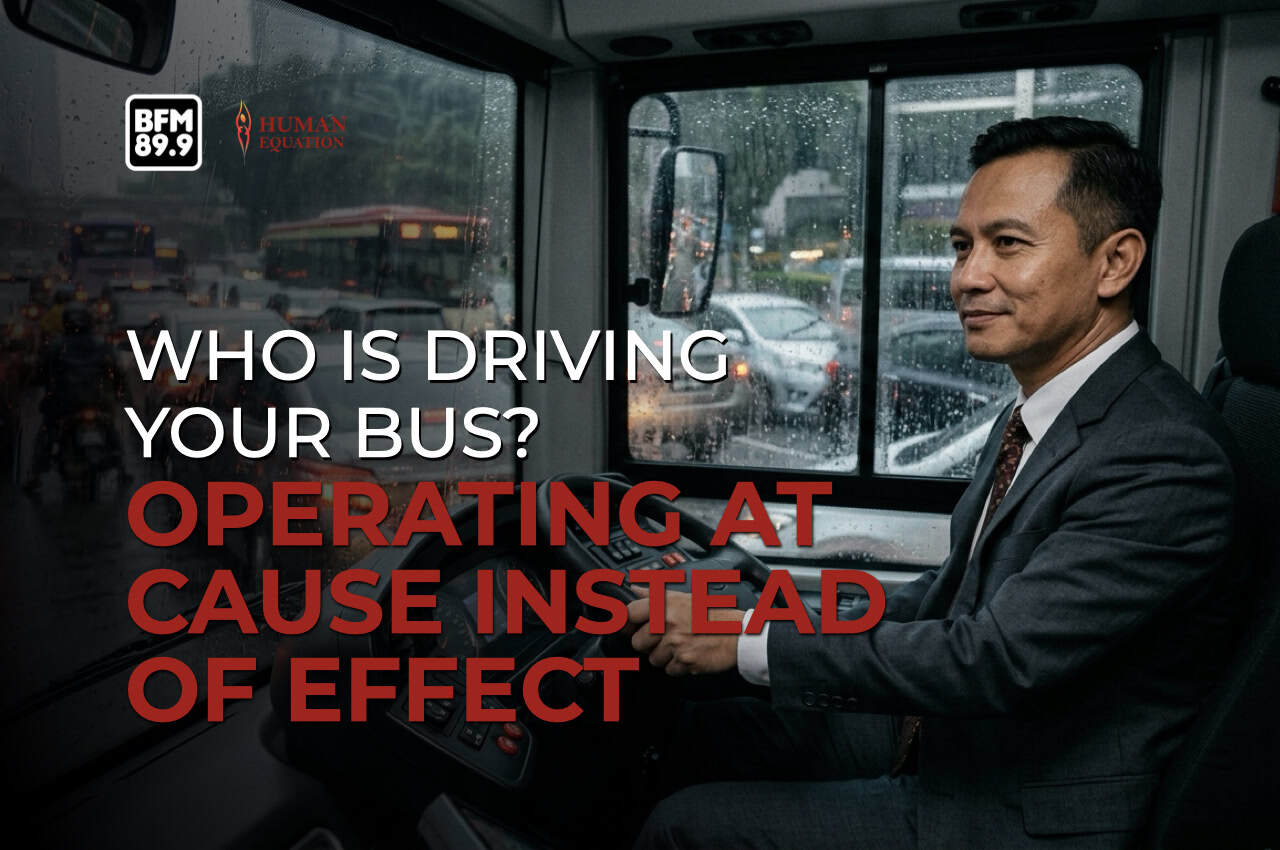
But the point is, you’ve got to stop short and say, “Who’s driving the bus?” You know, Richard Bandler, one of the founders of NLP, always said, “Who’s driving the bus?” Basically, who is in control of the bus that you’re in? Are you the driver deciding where you want to go, or are you sitting there and letting somebody take you to where they want to go instead of where you want to go?
Freda: Okay. And, you know, we’re going to hear from Rayhaana Omar after this, and how she operated at cause and not effect after this. I’m also speaking to Sheila Singam from Human Equation. It’s our “Tools for Transformation” series in Raise Your Game, BFM 89.9.
Commercial break: Business friendly Malaysia, BFM 89.9.
Freda: It’s Raise Your Game. Good morning. This is Freda Liu. I’m here with Sheila Singam from Human Equation and Rayhaana Omar, who is a radio presenter for Radio Islam in South Africa. She’s currently based in Malaysia. It’s our “Tools for Transformation” series, and talking about taking charge of results. And today, it’s about operating at cause instead of effect. So, Rayhaana, I want to hear from you a little bit about yourself, you know, and this operating at cause and operate… You know, what that meant for you.
Rayhaana: Hi. Hi, Freda. Thanks for having me here with Sheila on the programme today. I think… I think when I look at operating at cause in my life, for me, it was perhaps the most empowering time in my life because it allowed me to realise that the brain has these infinite possibilities that it wants to explore, and I am empowered to make the right choice.
One of the presuppositions in NLP is that I’m in control of my mind and, hence, my thoughts, just as you are in control of your mind and your thoughts. When that came to the surface for me and I realised, like Sheila said, “Whose bus is it? Who’s driving the bus?” and I realised that I need to be operating at a space where I’m in control, where I’m empowered, because I am the one making the decisions for my life – and that was mind-shifting and life-transforming for me.
Freda: Okay. I mean, what was that point? And I’ll have to say that Rayhaana is a lovely lady, in a burka and covered. And what were some of the things that led to you wanting to… Wanting to operate at cause, and were you not operating at cause before?
Rayhaana: I wasn’t. For most… For the majority of my life, I feel I wasn’t operating sufficiently at cause. I was on the effect side of the equation. And, like I would put it, I was more victim instead of victor in my life. And so, with the tools from NLP that I was instituted in and trained by Sheila, I came to realise that I have this choice.
And if you look at most Asian communities, you find that you’re often living your life for everyone else – for a community or societal expectations, for your parents, your grandparents, what’s expected of you. But when you can step out from that comfort zone and move into the stretch zone, you become who you’re meant to be.
So for me, it was really looking back at all the decisions I made in my life and saying, “There are no regrets of what’s happened, but what could have been done differently or done better if I was living at cause?” And learning about cause and effect was like striking a gold mine. It was like saying, “Hang on a minute. You know, who am I in this whole equation of my life, and who am I living for? Why am I alive? What am I meant to do? And why am I not operating at full cause in my life when I can do that?”
So for me, it was the belief to realise that I could consider alternatives, that I could plan, that I could act for myself, that I could enjoy my life for myself, yet live in a state where I’m respectful of others and their opinion of me. So it was a whole mind shift in saying that, for me, it was time to nurture myself. And if I’m ready to nurture myself, I need to start with self-love. To love myself, I need to accept myself. And when I’m ready for that, then I’m ready to live at cause.
Freda: Can you share a particular situation where you actually came to that realisation?
Rayhaana: Sure. I’ve been, like you said, fully veiled – face-veiled – for over 30-odd years. And it was a choice from myself; it was my own discovery and my choice. And along the way, with lots of travelling… I do a lot of outdoor sports, like kayaking, mountain climbing, dressed as I am. You always come in contact with people who may not be ready to accept how you dress, or it may not be part of their map of the world. And I was okay with that, but I was not okay with the feeling I was feeling about it.
Freda: Okay.
Rayhaana: Right? “Am I doing something wrong? Should I apologise for the way that I’m dressed? Should I be doing something that will make others more comfortable with me?”
But when I started living at cause, I was able to look within myself and realise that I have goodness, I have a personality, I have experience, I have information to share and experience – all of this. And I could then choose to live from that space and not be apologetic.
Another big choice for me was, about two years ago, deciding to start eating clean and to start exercising. And fast foods and all of processed foods is society nowadays, right? And I chose to change…
Freda: Rule number one.
Rayhaana: (Laughs) …to change that completely. Where for at least half of my day, it’s raw fruits and vegetables. I don’t really eat processed foods, hardly meat. And that was… In the past, when I was operating at effect, I would have thought, “What will my family think? Won’t it be socially awkward for everybody else?”
Freda: Right.
Rayhaana: Now, living at cause, I’m saying, “How does it make me feel when I’m eating and nurturing my body with what it wants, or when I’m working out and I’m drinking water?” Right? And yes, I’m aware of how others may feel, but I’m not taking that emotional baggage of others – and that works cause and effect for you. I’m not taking that emotional baggage and weighing myself down. I’m living ecologically. I’m taking into consideration the consequences, but I’m making the choices for myself.
Freda: So ultimately, it’s about being comfortable in your own skin?
Sheila: It is about being comfortable in your own skin. It’s about being confident and comfortable of the choices you make, and doing what your conscience and your heart and your spirit is telling you to do – not reacting. Basically, living at effect is reacting to the environment and people around you.
People who live at effect will ask, “Why me?” and they’ll give you reasons – multiple reasons – why they cannot or should not do something. And they always focus on the limitations. You have people like this even at work. You tell them, “Okay, let’s do this new project,” and they go like, “Cannot.” And they look at the ‘cannots’ before they look at the possibilities.
Freda: The possibilities, absolutely. Right.
Sheila: Right. And they also, when things don’t work out the way they expect or want, they focus on the failure: “Oh, you know, it failed. I’m a failure.” Whereas a person that operates at cause will look at it as feedback: “What can I take from this? What can I learn from this to improve the process better?” Okay.
You listen to the language. People who operate at effect will say things like, “I have to,” “I must,” “I can’t.” People who operate at cause will say, “I can”, “I will”, and want to.”
Freda: Right.
Sheila: Right? So the language will tell you.
Freda: You know, when people who come for your courses as well… Most of the people already at that, you know, or at that point where they’re wondering, “What’s wrong with me?” or at that point where they are already operating at a higher level, but seeing that we all have some sort of baggage that we carry with us. And I generally think I’m quite positive and all that, but there is always something left over.
Sheila: Absolutely. I have a range of people coming for my courses. You have the people who are really broken, people who say that, “Why am I alive? There’s nothing to look forward to.” I really like that. And then, after the nine-day programme, they have a 180-degree transformation and really go out there and are ready to embrace life.
I have the people who are really there already. They are operating at cause, like, maybe about 80%. And they still come, and they understand the reason why they need to endeavour to operate at cause 100%. It’s not about whether you succeed or not; it’s that knowledge inside of your head that, “I need to do this. Hey, right now, I’m operating at effect. I’ve got to stop myself and look at what I can learn from this negative situation. I’ve got to stop whingeing, and I’ve got to look beyond this to see where I can go with this. What is this teaching me in the school of life?”
Freda: All right. So for you, Rayhaana, you know, like, with this knowledge and all that, what are you doing next, you know, to operate at cause with your life?
Rayhaana: I think it’s a continuous and ongoing journey in life. For you, when you’re operating at cause, you’re discovering more about yourself each day. And that is very exciting. But when you wake up every day, like Sheila said, there’s possibility; there’s opportunity. And when you’re operating at cause, you wake up ready to discover yourself, ready to discover the world, and you expand your map of the world, and you allow in more love, more acceptance, more tolerance, more compassion, more empathy. So I think just every day waking up and knowing that you’re ready to discover more about yourself and the world – that is a journey on its own.
Freda: And we all have our off days. What do you do during your off days? You know, what are some, you know, tools that we can use?
Sheila: I think it’s always having this at the forefront: that I need to be operating at cause to make myself happy inside. You know, the poet Maya Angelou, she said that, “If you can change things around you, then do. If you can’t change the things around you, then change your attitude towards them.” And that’s what operating at cause is.
The world is not going to make you happy. You cannot rely on what’s outside of you – people and circumstances and whether you fulfil your ambition and all that – to make you happy, because contentment comes from inside. And that is the process of embracing living at cause. That when things are not ideal, when the world out there is ready to hit at you, you look inside of yourself and say, “You know what? I’m going to operate at cause, and I’m going to find that inner peace.”
You know, for example, if someone is standing there yelling at you, if you’re operating at effect, you say, “Oh, why is he yelling at me? He’s making me feel small. What’s wrong with me?” And, “I’m angry.” But if you’re operating at cause, you say, “You know what? He’s got his baggage. He doesn’t know how to behave. And that… I’m not going to take that on and, sort of, embrace that and allow that to affect who I am, because I am operating at cause and he’s choosing to be a real jerk. I’m not going to react to that and get into effect.”
Freda: Right. Okay. Any final thoughts, ladies?
Rayhaana: Well, I think that when you start living at cause in your life, you start clearing away the debris of limiting beliefs, the debris of negative emotions. You start discovering yourself, and that is very healing. That’s very empowering when you live from that space and you start discovering the inner you.
Freda: Madam?
Sheila: Operating at cause is a process. Like every skill in your life, it takes practice. It starts with you just sitting down today and saying and asking yourself, “All those times when you’ve lived at effect, how has it made you feel?” and then comparing it with all those times when you’ve lived at cause – you’ve made things happen in your life, you’ve made things happen in other people’s lives, you know, you’ve reacted strongly. How has that made you feel? Compare the feelings inside.
I had a student at one of my workshops saying that was the clincher for him. “I compared the feeling inside, and I realised operating… When I thought of the times I operated in effect, I really felt bad. But when I thought of the times I operated at cause, I felt strong, I felt powerful, I felt so empowered.” And that’s it. It’s about what it makes you feel inside.
Freda: All right. And we’ll hear from Sheila and another guest at the end of next month. It’s time for Christmas, time for the New Year. Sheila Singam from Human Equation and Rayhaana Omar in our “Tools for Transformation” series and Raise Your Game, BFM 89.9.
Thank you for listening to this podcast. To find more great interviews, go to bfm.my or find us on iTunes. BFM 89.9, The Business Station.