

Originally broadcast on BFM 89.9 – The Business Station: 🎙️ Listen to the Full Conversation: Sheila Singam discusses NLP in Business and Sales on BFM 89.9’s Raise Your Game podcast with Freda Liu and Nicole Rodrigues, founder and marketing director of Mountain Fresh Fruit Juices Asia. (Run time: 18:36 mins). Published on 25 September 2015.
Have you ever walked away from a high-stakes client meeting feeling as though you were speaking an entirely different language? We have all been there. You present a brilliant, feature-packed proposal, yet the client simply stares back at you with a blank expression, unmoved. It got me thinking about how so many brilliant entrepreneurs and professionals struggle to connect, purely because they miss the fundamental human mechanics of communication.
In business and sales, we often fall into the trap of believing that decisions are driven strictly by cold, hard logic. But human beings are inherently emotional creatures. We buy based on emotions, and then we rationalise those choices using logic afterwards.
This is where Neuro-Linguistic Programming, or NLP, becomes an extraordinary game-changer. Far from being a set of manipulative tricks, NLP in business and sales provides a deeply ethical, human-centric framework designed to build genuine trust, decode customer needs, and navigate unpredictable challenges with total resilience.
Key Takeaways
- Build Instant Rapport via Mirroring: Match posture, speech tempo, and body language to lower buyer resistance and establish immediate unconscious trust.
- Leverage Sensory Predicates: Align your language with your client’s dominant modality—visual, auditory, or kinaesthetic—to ensure your value proposition resonates deeply.
- Reframing Sales Objections: Shift buyer focus from immediate upfront cost to long-term value and competitive risk using NLP reframing techniques.
- Anchor Positive Emotional States: Connect your solutions to moments of peak buyer confidence and enthusiasm to accelerate decision-making cycles.
- Uncover Core Buying Drivers: Use precise NLP questioning models to identify the hidden motivations and decision-making criteria behind purchasing choices.
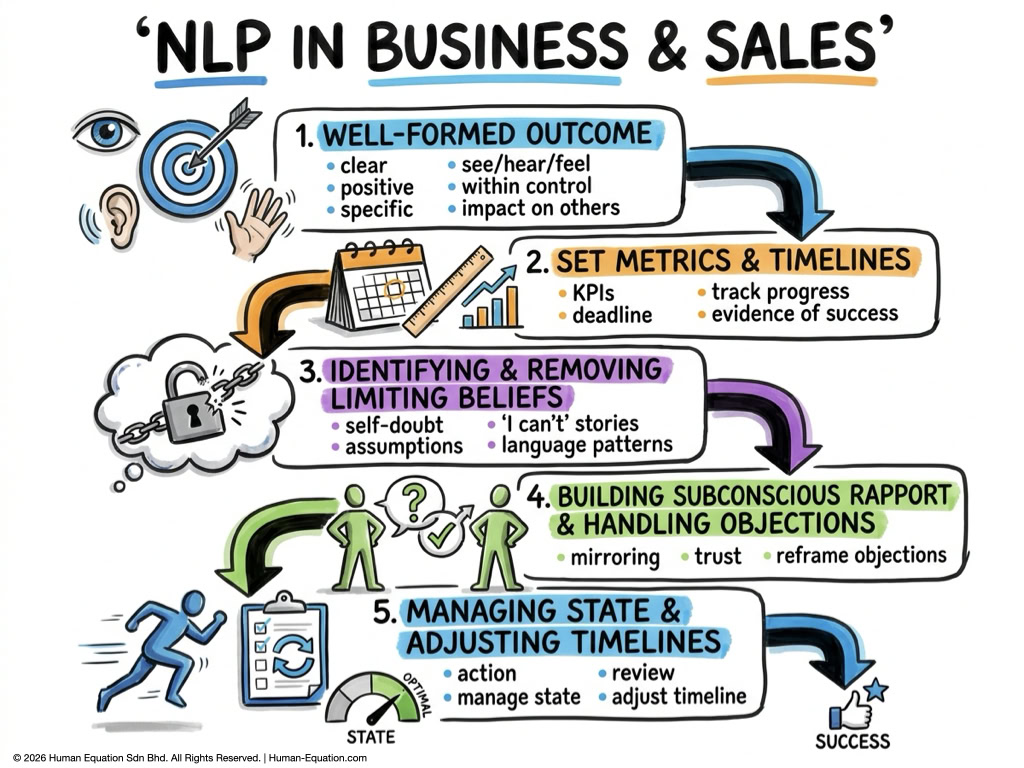
1. Clarifying the Well-Formed Outcome
The foundation of setting any goal—whether in personal development or commercial sales targets—is defining a clear, precise endgame. In NLP, we call this a Well-Formed Outcome. Unlike vague wishes, a Well-Formed Outcome requires you to get clear on what you actually want, framing it positively and in sensory-rich detail.
When you hold a clear outcome in your mind, your unconscious mind goes to work, tuning into your environment and pulling forward opportunities that help you achieve it.
Years ago, before I was formally trained in NLP, I sat down and wrote out a list of 10 major goals. I simply wrote them down clearly. Over time, I achieved every single one of them. That experience taught me the incredible power of structured clarity, prompting me to set bigger, bolder goals every year.
2. Setting Metrics & Timelines
A vision without concrete numbers and firm deadlines remains an abstract idea. To anchor your outcome into reality, you must attach specific Key Performance Indicators (KPIs), exact sales targets, and crisp timelines.
My friend and client, Nicole Rodrigues—who previously served as Managing Director and Marketing Director of Mountain Fresh Fruit Juices—paired her outcome planning with a vision board. She created a vision board placed where she could see it every morning upon waking and every night before sleep. By visually anchoring her business sales targets alongside personal aspirations—such as quality education for her children, personal milestones, and health targets—she primed her mind daily.
Within nine months of setting her specific sales target, she achieved her exact milestone.
3. Identifying & Removing Limiting Beliefs
You can possess the finest outcome and timeline in the world, but if you harbour internal limiting beliefs, you will continually encounter mental blocks.
Despite having a superior product, Nicole shared candidly that she suffered from a persistent belief that her company wasn’t “good enough” to secure prestigious five-star hotel accounts. Through targeted NLP processes, she identified and removed that self-limiting belief.
Once that mental restriction was erased, her confidence transformed. She approached those luxury venues with authority and unlocked doors that previously felt completely closed.
4. Building Subconscious Rapport & Handling Objections
Once your internal mindset is clear, execution relies on how effectively you connect with people, decode their needs, and address their objections.
Building Subconscious Rapport
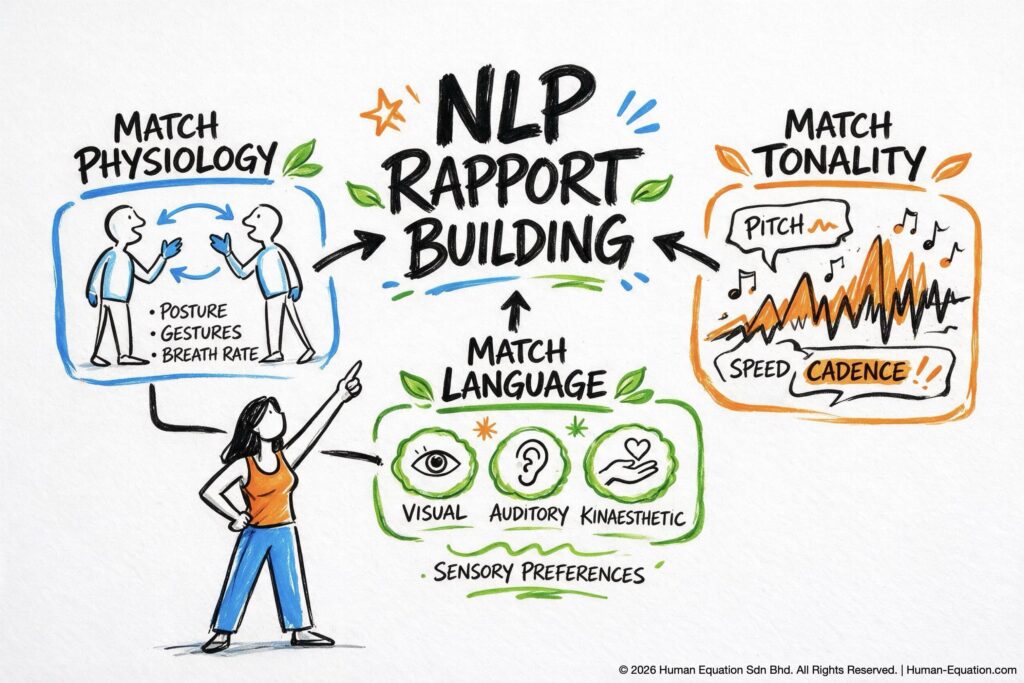
Fundamental to all relationship building is trust. A client does not need to be your best friend to trust you to deliver exceptional value. You establish that trust by meeting people where they are through matching and mirroring their physiology, tonality, and sensory language patterns (Visual, Auditory, or Kinaesthetic).
If you pay close attention, your client’s language will give away their exact preference:
| Sensory Preference | Language Indicators | Ideal Sales Approach |
|---|---|---|
| Visual | “I see what you mean”, “Clear” | Show visual demos, brochures |
| Auditory | “That sounds good”, “I hear you” | Focus on tone, clear discussion |
| Kinaesthetic | “Feel”, “Grasp”, “Run through” | Provide hands-on samples / brochures |
If you are marketing to a kinaesthetic buyer, you must let them touch, feel, or try the product. If your product is a massive piece of machinery or an abstract service, let them hold and feel the weight of your high-quality brochures instead. Communicating in their preferred style removes unconscious friction.
Case Study: Breaking Through an Unapproachable Client
Nicole used this exact tool to break through with an exceptionally tough commercial client whom her sales representative had failed to engage. When Nicole stepped in, she consciously matched his posture and movement subtly without him noticing, creating an immediate, comfortable space for open dialogue. The client felt an immediate sense of trust and signed the contract, securing a major account.
Eliciting Buying Sequences
Beyond sensory preference, every buyer operates with a specific sequence of buying values. You can elicit these values directly by asking what they looked for first, second, and third during their last purchase, then feeding back your solution in that identical order.
A Tale of Two Insurance Agents
I once had an insurance agent try to sell me a policy. I explicitly told him, “Here is what I want, package something that fits my specific needs.” Instead of listening, he insisted on forcing me through his standard, lengthy presentation slide by slide. He completely lost me, and I did not buy.
Shortly after, another agent arrived, listened to my exact criteria, and said, “Tell me what you want, and I’ll tailor it exactly for you.” He matched my values precisely, and I immediately put down a large investment with him.
Handling Price Objections
When clients raise price objections, standard salespeople retreat into defensive discounts. In NLP, we use the Meta Model to ask precise clarifying questions—such as “Expensive compared to what?”—and use inductive language to paint a sensory picture of value.
Case Study: Addressing Price Objections with Metaphors and Proof
When prospective clients quibbled over the price of Mountain Fresh Fruit Juices, Nicole positioned Mountain Fresh as the “Mercedes-Benz or Rolls-Royce of fruit juices.”
When they probed further, she revealed that a single 300ml bottle contains the cold-pressed juice of eight premium apples, with no added water, sugar, or preservatives. The moment buyers saw the tangible quality and value proposition, price ceased to be a hurdle. When value is clear, buyers happily pay a premium.
5. Executing, Managing State & Adjusting Timelines
Execution takes place in an unpredictable business world. When deals fall through, client meetings go off track, or market conditions change, NLP state management tools allow you to step out of unresourceful emotional states so you don’t wallow in disappointment. You allow yourself to acknowledge the setback briefly, reset your internal emotional state, and step right back into action.
Crucially, if you don’t hit a specific goal within your original timeframe, don’t beat yourself up or be hard on yourself! Be kind to yourself. Check for any hidden limiting beliefs, adjust your timeline, extend your horizon, and enjoy the process!
Frequently Asked Questions
How does NLP in business and sales improve everyday client negotiations?
NLP in business and sales equips you to build immediate trust through subtle physiological matching, decode your client’s hidden buying values, and address core concerns using inductive language and benefit-driven framing. It shifts negotiations away from price battles toward mutual, value-added outcomes.
Can NLP tools help sales teams overcome severe rejection?
Yes. Through state management and the Well-Formed Outcome model, sales professionals learn to detach emotionally from temporary setbacks, maintain psychological resilience, and focus steadfastly on long-term goals.
Is matching and mirroring client behaviour manipulative?
Not at all when done with integrity. Matching and mirroring is a natural human process that signals empathy, active listening, and respect, laying the essential groundwork of trust required for any healthy business relationship.
How can I learn to apply these NLP tools effectively in my own business or sales team?
While understanding the concepts is a great start, mastering NLP requires hands-on practice, feedback, and real-world application. Immersing yourself in a structured NLP training programme gives you the practical experience to naturally integrate rapport-building, state management, and clear goal setting into your daily professional conversations.