


Originally broadcast on BFM 89.9 – The Business Station: 🎙️ Listen to the Full Conversation: Sheila Singam discusses How High Performers Overcome Limiting Beliefs with NLP in Work and Life on BFM 89.9’s Tools for Transformation podcast with Freda Liu. (Run time: 18:40 mins). Published on 30 September 2016.
Have you ever wondered why so many talented, driven individuals hit an invisible ceiling in their careers or personal lives? More often than not, it isn’t a lack of effort or technical skill holding them back; it is the quiet, unspoken limiting beliefs running in the background of their minds.
In this article, I want to unpack how practical Neuro-Linguistic Programming (NLP) tools can dismantle these internal barriers, transform our communication, and reframe our mindsets. To show you how this works in the real world, we will look at two remarkable case studies:
First, a technically brilliant manager whose team completely froze her out—and how a simple shift in her internal map turned resistance into genuine trust;
Second, a high-achieving professional trapped in a deep cycle of guilt and self-doubt over family planning, who completely transformed her physical reality once she broke free from her limiting beliefs.
Whether you are navigating tough team dynamics or battling unseen personal roadblocks, shifting your mindset can unlock extraordinary results in work and life.
Key Takeaways
- Identify Subconscious Mental Blocks: High performers leverage Neuro-Linguistic Programming (NLP) to uncover hidden inner narratives and self-imposed ceilings that impede growth.
- Master Cognitive Reframing: By shifting linguistic patterns and internal dialogue, individuals transform self-doubt into constructive, action-orientated mindsets.
- Utilise Resource Anchoring: NLP techniques enable leaders to trigger grounded, confident mental states on demand during high-stakes work and personal situations.
- Rewire Behavioral Patterns: Replacing automatic reactive habits with intentional neuro-sensory responses fosters long-term emotional resilience and career adaptability.
- Sustain Peak Performance: Overcoming limiting beliefs allows professionals to achieve high-level goals without sacrificing mental well-being or work-life harmony.
NLP Case Study 1: A Young Manager’s Ivory Tower Trap
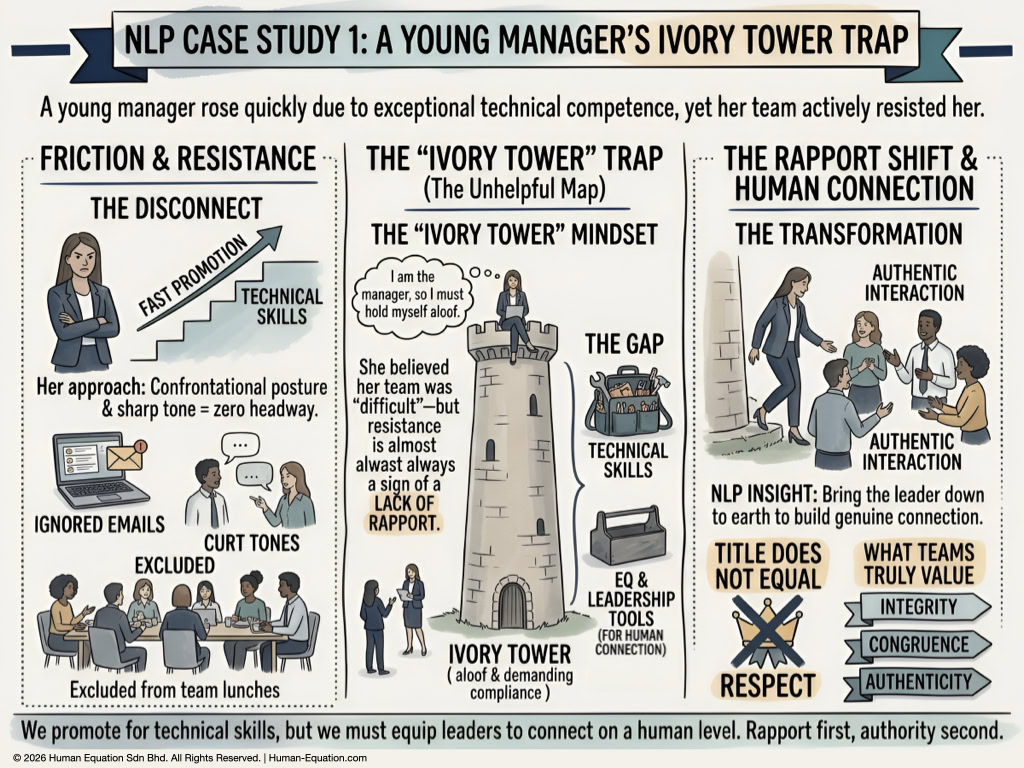
A young manager came to me after rising quickly through the ranks due to her exceptional technical competence. Yet, despite her expertise, her team actively resisted her.
They ignored her emails, responded in curt tones, and excluded her from team lunches. Her posture was confrontational, her tone was sharp, and she was making zero headway.
She believed her team was simply being difficult. But when we unpack workplace friction, we quickly learn that resistance is rarely about the other party—it is almost always a sign of a lack of rapport.
We promoted her for her technical skills without giving her the essential EQ and leadership tools required to lead human beings. She was operating under an unhelpful internal map: “I am the manager, so I must hold myself aloof, sit in my ivory tower, and demand compliance.”
Younger teams do not care about your job title; they care about your integrity, your congruence, and how authentically you interact with them.
Keys to Overcome Limiting Beliefs with NLP: Shifting the Internal Map
To turn her situation around, we introduced four fundamental success beliefs from Neuro-Linguistic Programming (NLP):
- Resistance is a sign of lack of rapport: If people resist you, you have not taken the time to connect with them.
- Perception is projection: What you hold inside your mind is precisely what you project outward to others.
- The meaning of your communication is the response you get: Never assume people receive your words the way you intended; everyone listens through their own filters.
- You are in charge of your mind and therefore your results: You hold total ownership over the thoughts and beliefs that drive your external outcomes.
We guided her through an exercise called Perceptual Positions. We asked her to step out of her own body and view her interactions from a neutral third-party perspective.
Looking back at herself, she finally saw the unapproachable, “holier-than-thou” stance she was projecting. When she stepped into her team’s shoes, she realised how alienating it felt to have a former peer suddenly pull rank.
She immediately adjusted her posture, learned to match and mirror communication styles, and began inviting team members out for casual one-on-one chats with no hidden work agenda. Once she shifted her internal state, the wall of resistance melted away
| Workplace Challenge | Invisible Limiting Belief | The NLP Breakthrough Tool | Practical Outcome |
|---|---|---|---|
| Team Isolation & Resistance | “I am the manager, so people must follow my title and hierarchy.” | Perceptual Positions & Rapport Matching | Step outside yourself to observe your tone, match communication styles, and build genuine rapport. |
| Personal & Career Stagnation | “My failure is genetically predetermined or caused by external factors.” | Dismantling Limiting Beliefs & State Management | Separate physical facts from mental assumptions, drop unproductive guilt, and focus on well-formed outcomes. |
NLP Case Study 2: When Limiting Beliefs Sabotage Personal Life
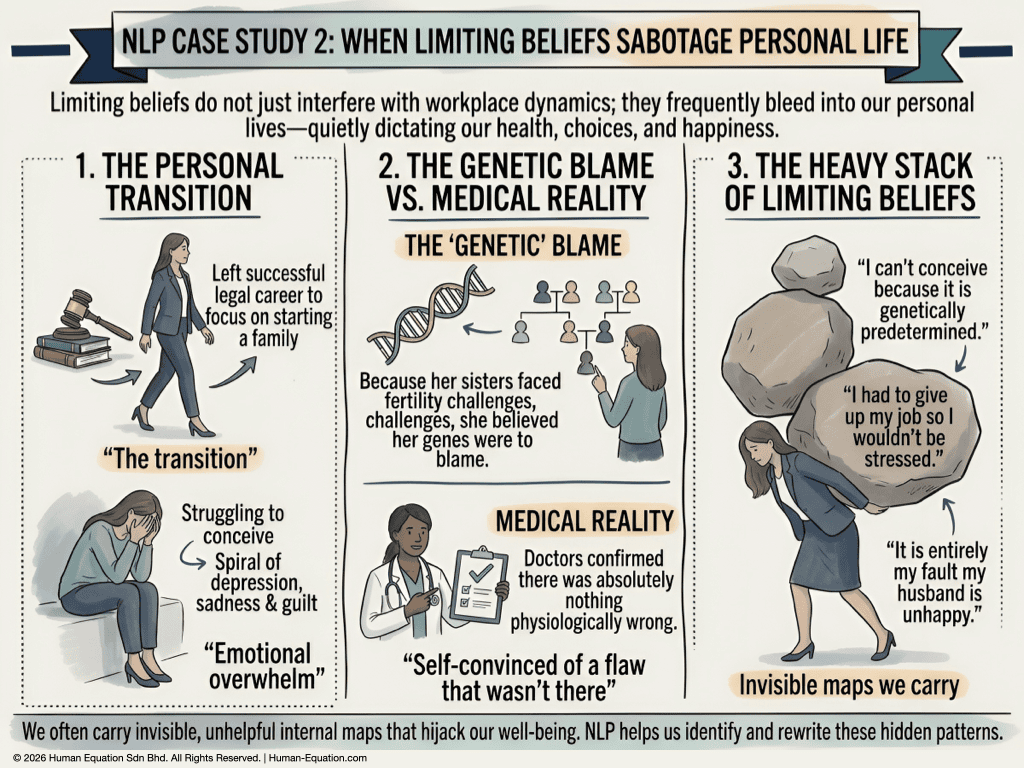
Limiting beliefs do not just interfere with our workplace dynamics and team relationships; they frequently bleed into our personal lives, quietly dictating our health, our choices, and our happiness.
I remember coaching a client who had made the difficult decision to leave her legal career. She and her husband, who was also a lawyer, had decided to focus entirely on starting a family. When she struggled to conceive, she fell into deep depression, sadness, and overwhelming guilt.
She had convinced herself that she was genetically flawed. Because her sisters had experienced similar fertility challenges, she firmly believed her genes were to blame. Yet, when she went for medical check-ups, her doctors confirmed there was absolutely nothing physiologically wrong with her.
When we sat down together, it became clear she was carrying a heavy stack of invisible limiting beliefs:
- “I can’t conceive because it is genetically predetermined.”
- “I had to give up my job so I wouldn’t be stressed.”
- “It is entirely my fault my husband is unhappy.”
Keys to Overcome Limiting Beliefs with NLP: Dismantling Unproductive Guilt
Whenever a client comes to me weighed down by guilt, my very first step is to help them remove it entirely. Guilt is an extraordinarily unproductive emotion. Fear and anger can keep us safe in a fight-or-flight situation, but guilt simply keeps us trapped in past regret.
By systematically dismantling her limiting beliefs, we began to ground her mindset in clinical facts. Her doctor had confirmed her body was in perfect working order, making it clear there was no reason to hold onto a narrative that said otherwise.
Next, our focus shifted toward tackling her underlying assumptions about her career and marriage. Sharing stories of successful women who managed fulfilling careers while raising healthy families allowed us to plant fresh, empowering beliefs in their place.
Most importantly, we addressed her “mind-reading”. She had convinced herself that her husband was deeply unhappy with her because he wanted a son to play soccer with. We do this all the time, don’t we? We project our own anxieties onto others and assume we know what they are thinking.
I gave her state management tools to rediscover excitement, cleared her mind of self-imposed pressure, and encouraged her to have an open, honest dialogue with her husband. Once she let go of the guilt and took back control of her mind, she felt empowered to return to work.
Shortly after shifting her internal map and releasing that emotional weight, her physical state responded—she successfully conceived and is now expecting her baby.
“The mind is where it all starts—your health, your career, and your relationships. Clear the mental clutter, and your reality will quickly follow suit.”
If this dynamic sounds familiar to what you or your team are navigating right now, let’s chat. Send a quick message to our team at Human Equation, and let’s explore how practical NLP tools can help you reset your internal map and bring the human element back into your leadership. Click here to view our NLP Programme.
Frequently Asked Questions
What are the most effective NLP tools to overcome limiting beliefs with NLP?
The most effective tools include using Perceptual Positions to view conflicts objectively and applying pattern interrupts to break negative thought cycles. You can also apply NLP presuppositions—such as “perception is projection”—to take full ownership of your internal state and daily results.
How does matching and mirroring help build rapport in business communication?
Matching and mirroring physically, tonally, or linguistically creates a subtle, subconscious sense of familiarity and trust. When you reflect a person’s pace, tone, or key vocabulary, their defensive barriers lower, making collaborative communication far easier.
How do internal mindsets impact physical performance and well-being?
The mind directly influences physical well-being and performance outcomes. Holding onto chronic stress, assumptions, or unproductive guilt projects negative signals that impact how we interact with others and how our body functions under pressure.


