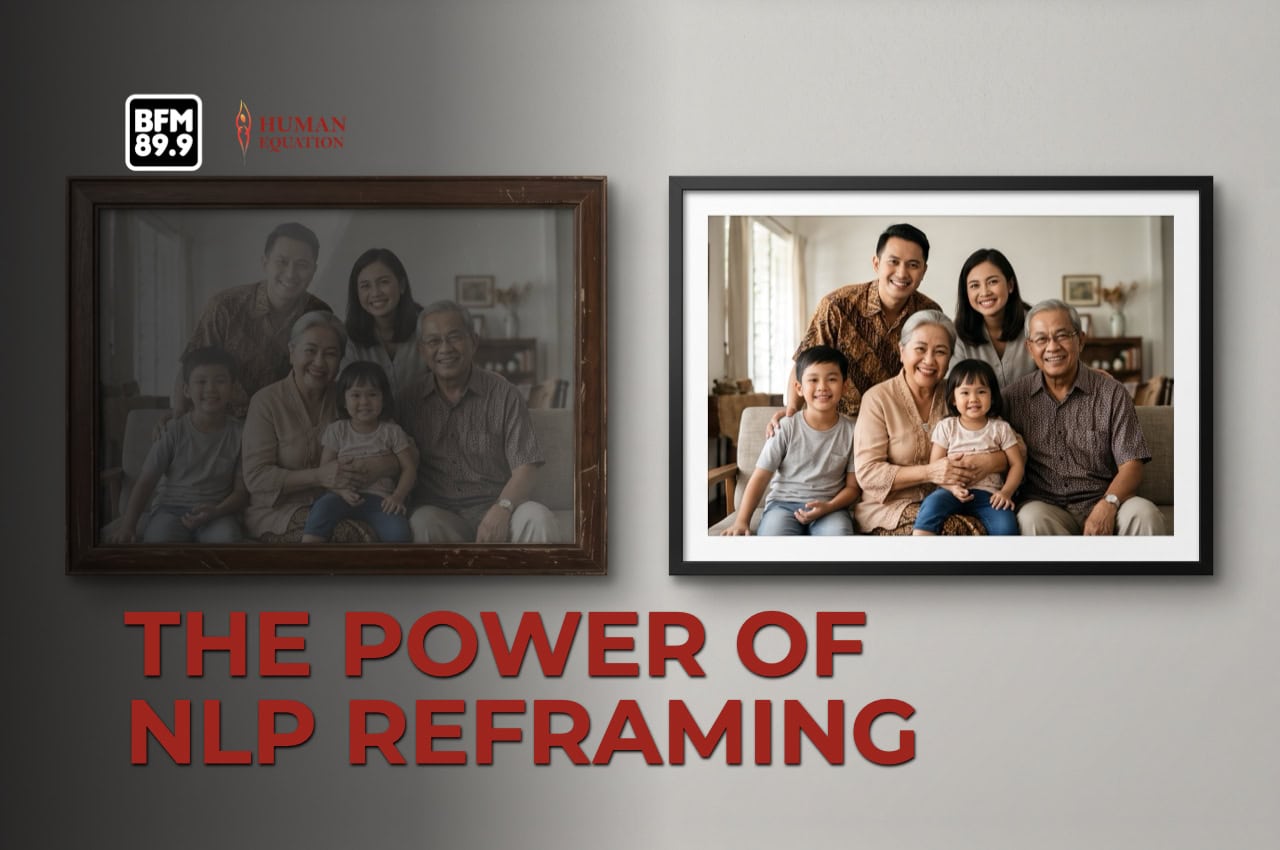
Freda: Good morning, this is Freda Liu. It’s Raise Your Game and we’re talking about a very interesting topic today. Sheila Singam from Human Equation is here together with another guest. But before that, have you ever had an old picture that you wanted to throw out because it didn’t look very pretty to you? Then someone took it from you, put a new frame to it, and suddenly the picture looked very chic. So, what made the difference? The frame. So, the same thing happens when we put a different frame to a situation of behaviour. It can cause you to see someone’s behaviour in a whole new light, or find a positive meaning in a negative situation and instantly lift up your feelings. So today, we’re talking on the topic of reframing.
Sheila Singam, welcome back! Final Friday of the month, Tools for Transformation series. And Regina Foo, independent marketing consultant, here to talk about how this whole aspect of reframing has helped her. Now, we’re going to start off with Sheila. You know, what reframing is and some examples of what reframing is.
Sheila: Okay, reframing is actually the process of putting a different meaning to someone’s behaviour, or something that they said, or a situation that happened in your life so that you actually take a positive learning, a positive slant from that.
Now, Viktor Frankl, who was a Jewish psychiatrist and a Holocaust survivor, he was in a concentration camp and he studied people while he was there. And after the war, he actually worked with these Holocaust survivors. And he found that the one thing that differentiated people who could move on with their lives and lead productive lives after the horrific things they’d gone through, and what separated them from those who couldn’t move on, was the fact that those who could lead productive lives were able to take a positive meaning from what had happened. They were able to take positive learnings, and take it and apply it to their lives.
So, reframing is actually looking at a negative situation and saying, “What is the positive thing can I take from this?” Let me give you a simple situation, Freda. You decided to go shopping. Okay? And then, you get into the car—you dressed up, all that, to go shopping, feeling very excited. And then, you get into the car and then “bateri mati” (find yourself with a dead battery). So, you are like, “Oh no, I can’t go shopping.” You either can sit there and kick the car, get all stressed out that your plans were thwarted, or you can sit down and say, “Okay, what does this mean? Maybe I’m not meant to go shopping. Maybe I’m meant to go home and do something else.”
Freda: You are meant to go shopping… for a new battery.
Sheila: Possibly that! But while you’re waiting for someone to bring the battery to you, you can actually sit down and say, “Now, what can I do? Maybe I’m meant to have some downtime. You know, maybe I can sit and go and check on those emails, or get onto Facebook, connect with some old friends, make some calls, do some marketing for my business.” I don’t know. It’s just how you look at it. Or if you’re, you know, if it’s raining, and you say, “Oh no, it’s raining. That’s going to be a jam in Kuala Lumpur.” Or you could say, “Great, it’s raining! It’s such a hot day, it’s going to cool the day. And no, I’ll just stay at home and chill out over here, or go out somewhere nearer where I won’t get stuck in a jam.”
Freda: You know how I look at these situations when it is raining? I just remember the haze.
Sheila: Oh, yes!
Freda: And then my mind is totally reframed. I’ll say, “Thank God for the rain, and we will have clear skies.”
Sheila: Rain better than haze.
Freda: Rain better than haze. That is one of the things. And then when it comes to that—because it has happened to me when my battery died. Okay, a couple of times it has happened. And I’d say, “Thank goodness I’m at home and not stuck somewhere, right?” So, I’m here at home. “Thank goodness I have a car. Thank goodness I can afford a battery, right?” So, those are the things. I mean, so far, thank God it happened at home and not anywhere else.
Sheila: Yeah, we know we are so anchored to our phones, right? It has now become an extension—another limb, you know? So, the other day, I was going to go out to have a nice dinner with my daughter. Spend some quality time with her. And I left my phone at home. And I was like, “Aiyo, I left my phone at home!” But you know what? Because I left my phone at home, I wasn’t checking messages.
Freda: You could actually talk to your daughter.
Sheila: I could focus 100% on her. We really had a nice dinner. Whenever negative things happen, bad things happen, things don’t go your way, always look at it and say, “Now, what good can I make out of this?”
Freda: Let’s give you a work situation which is very common: backstabbers. What do you do? How do you see the positive in backstabbers?
Sheila: Well, okay. I always have a theory, and this is something I learned long ago before I went into training and development, and coaching, all that. Something I read somewhere. It says, “For every cloud of criticism thrown at you, look for the grain of truth.” So, what do you learn from this? People are backstabbing you. What you learn from this is maybe you need to have boundaries. Sometimes, you know, we are just very transparent people—people like you and me. Just no holds barred, just very transparent. We believe the best in people. We go and tell everything to everybody, and you know, confess your heart and soul and all that. And then you find that sometimes, people can use that against you.
So, what this has taught me, because I’ve been there as well, it’s taught me to be more circumspect in what I am saying to people, in how much maybe of my work or myself I am revealing to people, you know? So, you then learn how to draw boundaries, because some of us have got no boundaries. We just let people walk all over us.
Freda: I think the word is discernment.
Sheila: Discernment. That’s another way of saying “have boundaries”. I’m not saying be selfish. But I’m saying be discerning and be careful. You also got to be able to take information and messages from the people you deal with. And very often, I find that we need to listen to our gut instinct when it comes to people. You know, sometimes your gut instinct would be telling you that, “Hey, just be a little bit careful of this person.” They’re actually, you know, sort of draining your brain or picking your thoughts, and they’re going to take it to another level. I’m very generous with my knowledge. But if I sense that someone has got an agenda, then if my gut tells me, “Just be a little discerning,” then I pull back.
Freda: Okay. Anyway, just back to this concept of reframing as well. How is it useful? I mean, basically, it’s like, “Don’t look at it negatively, look at it positively,” you know? So, how is that useful in life?
Sheila: Well, your power of your thoughts. Okay, we in NLP, we believe in this concept of “perception is projection”. What you have inside your mind, your thoughts, is what you’re projecting out there. So, it’s like the Law of Attraction, if you will. Whatever that you have inside is what you’re attracting; where your focus and attention is, is what you’re attracting into your life. So, if you have positive thoughts, you have a positive plan, say, “What can I learn? How can I move on to make full use of this adversity and learn from it?” Then you are projecting positivity out there, and that’s what you will attract back.
But if you are constantly having negative thoughts, I tell you, Freda, even God cannot help if you’ve got negative thoughts and negative beliefs. Seriously, even God can’t help you. Because you have to first take the initiative of having positive thoughts, translating that into positive beliefs, projecting that out there for anyone or anything to be able to, you know, come back and help you, because you might have things lined up there to help you.
Let’s say you don’t have a job, okay? And you sit down and lament, “I don’t have a job, and no one wants to employ me, and you know, I’m not employable, that’s why they threw me out of my job,” and you’re going whinging, whinging like that. What you are projecting out there… if someone out there looks at you and says, “Hey, aiya, don’t want lah, this person is so negative. I don’t think I even want to go and talk to him about the possibility of a job.” So, you’re actually already cutting off any supply of positivity. You’re emanating the negative vibes.
Freda: Right. Okay, so anyway, we’ll talk a little bit about reframing and how that’s helped Regina, who is an independent marketing consultant. After this, of course. Sheila from Human Equation has been talking to me. This is our Tools for Transformation series. Stay tuned to Raise Your Game, BFM 89.9.
[Commercial Break: Benchmark for Managers. BFM 89.9.]
Freda: This is Raise Your Game. I’m Freda Liu. You’ve just joined us. I’m here with Sheila Singam from Human Equation in our Tools for Transformation series. She comes on the final Friday of the month, which means she won’t be coming on at the end of December because it is… oh, well, it is… oh, because it’s a holiday! This is January 1st, 2016, so this is it. Anyway, we’re talking about reframing, and Regina Fu, independent marketing consultant, is here with her as well. So, this whole idea of reframing, looking at the situation, behaving differently… maybe Regina can tell us a little bit about where you were at before you discovered this whole concept of reframing, what was happening in your life and all that.
Regina: I was invited to attend a half-day workshop at Sheila’s company, which I went, and she talked about emotional quotient. And emotional quotient is a session where you actually evaluate your own values in life: is it really taking you in the right direction you want, in the context of work, your family, or your love life? And I was actually in the midst of looking for a job, in between jobs. And really did not know what I really wanted to do next. So, this session actually helps me look at my values—where is my value, what is most important to me. And from that, I discovered that what I thought was important, right at the top of “what do you need in life, at work, what would work give you”… the first thing is money. But at the end of the day, when all the values were given out, it wasn’t money that was the most important thing that drives me.
Freda: Okay. What did you discover that drove you instead?
Regina: It was having self-control and power in my life to do the things I really want to do. And with that comes the passion. With that comes the independence to do the things that would make me happy. And from there, it opened up a whole new world. It was basically an “Aha!” moment for me. And when Sheila held the next public course for NLP, I signed up for it. And within the context of that whole NLP course, which was an intensive 8-day course, I discovered one of those aspects that really appeals to me is reframing.
Freda: Hmmm. Okay.
Regina: Reframing changed the way I looked at life. It changed my perspective of how I see myself, of how I see situations that are beyond my control. And indirectly, it’s actually empowered me to do the things I really want to do.
Freda: Give me one situation where you were reframed.
Regina: Where I was reframed. Okay. I told you that I was in between jobs and I was unemployed. It was a situation beyond my control. In the initial situation, I was like what Sheila was saying: “What am I… I have been applying for so many jobs, I can’t get them…” Whinging, you know? And that, basically, projection—it doesn’t project a very good, you know, positive image, right? And it also doesn’t give me that self-confidence and the self-belief that, “Yes, I am capable of getting a better job, a better situation, or getting out of this.”
Reframing has actually taught me, in the whole course of NLP, to get rid of my own self-limiting beliefs, get rid of the words I put in my mouth, and actually turn it around and say, “Okay, so now I’m in this situation. I don’t have what I want to have, but what can I make out of this? How can I tap onto my existing and onto my talent and do something that I really like, I really love?”
And from there, I discovered that there are certain aspects I really like. Now, how do I focus on this, then? How do I then expand on this? And what has happened after the NLP course is I’ve gone on to take different steps in my profession. It has convinced me so much that this is something everyone actually could give to themselves. It’s the best gift that you can actually give to yourself.
Freda: It wasn’t money, now, that would be directing you.
Regina: It was the passion. It’s doing what you really believe, and also having that independence to do it the way you want it to be done.
Freda: Right.
Regina: It’s not being, I would say, moine cloistered to an environment, you know? Beaten into shape to behave in a way that people expect you to conform.
Freda: Okay. You know, just with that as well, you know, Sheila, sometimes when you say, “You know, she’s got to look at it this way,” but there are some people who say, “Look, here’s a situation, you know. I’m not driven by money, but I need to get that job right now because I don’t have money, right? How am I going to…” And even trying to be positive about things, it’s like, “Can I just take the first job that comes into play because I’ve got to pay the bills?”
Sheila: I think that was pretty much the situation Regina was in when she started. But by sort of exuding this positive outlook in life, reframing her circumstances, and saying, “Okay, I’m unemployed, but now I can actually pretty much go and explore anything I want, not limited by a particular job,” all sorts of opportunities came at her. People were like… she wasn’t even putting it out, but it was like you were sending out these signals, right? All sorts of opportunities came, and she did actually get…
Freda: And she could turn down offers.
Sheila: Yes, she did get a very good offer that would have given her job security, right? But she decided not to go for it because she had elicited her values. She said, “Well, that doesn’t align with my values. I would be going back into the, you know, the cycle.” You know, the hamster-on-the-treadmill cycle, and she didn’t want that because she’d been there for years. So, knowing what her values were gave her the freedom. And inside of her, it didn’t resonate.
I always tell people this, Freda: if it doesn’t resonate with you, hang on a bit. Keep a positive outlook so that you are sending out the right signals for the right things to come back to you. And it did come. It did come—the opportunity and the offer came which allows her to work independently, you know, from home, very much independently, long-distance, and with good money. She got everything she wanted, you know.
Freda: And was it just… I mean, in that situation, were you surprised just by reframing that these things came about, or…?
Regina: I was surprised by it. I was surprised by it. But it gives me that conviction and that self-belief. It gives me that courage as well. When all these things start happening, it starts trickling in. And it doesn’t stop. And it hasn’t stopped. And the effect of NLP is still there. What I would like to emphasise is reframing actually makes you become very conscious of your own actions, of the words you put in your mouth, of the signals you want to send out, and of what you want out of life, out of people.
Freda: Right. So, are they right now situation-based? I mean, “Ugh, I gotta reframe, I gotta reframe.” Are there situations like that? And now you’re conscious that, “I better reframe”?
Regina: Yes, yes. I know I do that every day.
Sheila: It’s the same with me as well. I do that all the time. Yeah, we need to, because even in the issue of health, for example, if you keep saying, “Oh, I’m sick, I feel sick, I feel sick, I feel sick,” that’s what you’re attracting. So, even though I feel sick at that point, I feel it, but I’m going to fight it and I’m going to say, “Well, you know what? I’m going to be well. I’m going to choose to be energetic.”
Freda: “I have a bundle of energy.”
Sheila: Yeah, your words are so powerful, because death and life are in the power of the tongue. Yeah. Okay, so it’s pretty much that you need to start doing it consciously at first, and then after that, you will find that it comes naturally. And you know what you will find? You will start attracting positive people, and all the negative people just go away. Because they’ll come to you and they’ll want to whinge, and then you’ll be reframing them. And then after a while, they say, “You know what? It’s just very painful talking to you, because you don’t empathise with us, and you don’t understand, and you’re not letting us whinge.” In their minds, they’re saying that. But by the end of the day, the whinging is not productive for anybody.
Freda: You know, and one of the things that I actually discovered this year—you know, unplanned and just came out—was, you know, the whole thing… like, for the longest time, “I don’t like office politics. I don’t like politics, right?” That was a word, a statement I always used until I heard it from Anne Abraham, right? She’s from the 30% Club. And she was just saying… it was just a comment in passing: “It’s team dynamics, how different people just need to be communicated differently because they also have a goal in mind. So, you communicate to them how it meets their objectives.” I was like, “Wow, I never looked at it that way.”
Sheila: That’s a powerful reframe.
Freda: It was like, “Wow, it’s just team dynamics.” When I look at things, I’m like, “Okay, what’s the team dynamics here?” And I just look at each individual differently, and “how would it appeal to them as an individual?” So the word, you know, that whole… because “I don’t like office politics,” you’ll also attract that.
Sheila: It’s the same thing. Like in my trainings, in my corporate trainings, one of the biggest things I find in Malaysian companies is the inability to receive and give feedback in an elegant way. People don’t know how to give feedback because they think it’s going to, you know, cause someone else to lose face, and they don’t know how to take feedback. So, the first thing I do in my trainings is tell them to reframe the word “criticism” into the word “feedback”. Feedback is good. Feedback helps you to learn. Feedback helps you to grow and go on to, you know, more empowered ways of behaving. But if you look at “criticism” itself, the word itself is just so negative.
Freda: Yeah, right? “Criticise.”
Sheila: Yeah. So once they are able to reframe the word, then we give them the tools to actually give feedback in an elegant way, and it’s gone down really, really well. I mean, I can sit down and put in a whole heap of really sophisticated tools into a training program for two days for team dynamics, right? Then they all come back and say, “You know what’s the best one we like? How to receive and give feedback, because we don’t know how to do it well.”
So, that in itself is a reframe. When you reframe whatsoever is happening and see what is the positive learning you can take from it, and how it is going to help you grow. Because growing is good. That’s what we’re here for. We’re all supposed to evolve into better people. If you’re the same person you were 20 years ago, then I’m very sorry for you. So, how do we learn? How do we grow? It’s by taking the feedback from people. It’s by looking at how we behave in certain circumstances, and how we could behave better to get positive results. Because at the end of the day, all your results are actually, in a way, inadvertently, indirectly, a result of what you have in your mind.
Freda: Right. So okay, I guess, Regina, you know, how else has this concept helped your life? You know, any parting words for this?
Regina: Reframing helped me to manage my down-state.
Freda: Okay.
Regina: If I want to be in a positive state, then I have to be very conscious of how I look at things. And like Sheila was saying, if you’re caught in a bad circumstance or situation—”I can’t go shopping”—actually, yeah, maybe it will help me save money! So, it’s looking at adverse situations, even big or small, and making the best out of it. Because I think at the end of every situation, there’s a flip side of a better way, and everything happens for a reason.
Freda: “Everything happens for a reason” words. Parting words?
Sheila: Well, I would just say if more people would adopt the technique of reframing, that is, to see the positive in all circumstances, the positive in people’s behaviour, looking beyond people’s behaviour to see people are really, you know, beautiful. People really have positive intentions for themselves. If you are able to do that, I’m telling you, you are going to enjoy better health, you’re going to get better results in your life, you’re going to go to work happier every day. You’re even going to have better relationships because you’re seeing people in a different light, all right? And that is basically a fundamental thing to actually contributing to being happy. People always ask me, “What is the secret to happiness?” I’ll tell you: one of them is reframing.
Freda: All right, that’s all for this week. I’ve been speaking to Sheila Singam from Human Equation and Regina Fu, independent marketing consultant, in our Tools for Transformation series, Raise Your Game, BFM 89.9.
[Commercial Close: Thank you for listening to this podcast. To find more great interviews, go to bfm.my or find us on iTunes. BFM 89.9, The Business Station.]