

Originally written by Sheila Singam and published in The Star in January 2021, Becoming Bamboo People explores how building personal resilience and cultivating inner flexibility enable professionals to navigate uncertainty, bend without breaking, and thrive amidst rapid career disruption.
There is a particular, quiet panic that settles in when you feel the ground begin to shift beneath your feet. Whether it stems from an unexpected corporate restructuring, an industry turned upside down by rapid technological shifts, or simply a deep, persistent whisper reminding you that you have outgrown your current path, standing on the precipice of uncertainty can feel deeply daunting. In a world that demands continuous adaptation, building personal resilience is no longer just a desirable soft skill—it is our absolute lifeline. True resilience, however, is rarely about donning heavy armour to withstand life’s blows; it is about learning how to bend gracefully without breaking when the tempest blows hardest.
If there is one profound truth that life repeatedly reinforces for me, it is that the human spirit is a remarkably adaptive force. Extreme darkness rarely snuffs out our capabilities; instead, it rekindles a radiant flame within us, showing us that we are vastly stronger than we often believe.
When unexpected disruptions shake our foundations, they bring a mixture of uncertainty and loss. Yet, they also demand the very best of our human capacity. In adapting to unexpected turns, we learn to become flexible, creative, and agile.
Paradoxically, these very qualities form the essence of true resilience. While we often imagine strength as rigid toughness, the true definition rests in the capacity to recover quickly and spring back into shape after difficulty. Being resilient does not mean remaining unyielding or set in your ways; it means cultivating personal agility.
Key Takeaways
- Resilience as Agility: True personal and leadership resilience is defined not by rigid, unyielding toughness (the Raintree approach), but by the capacity to adapt, bend under extreme pressure, and recover quickly (the Bamboo mindset).
- The “No-Lose” Decision Framework: Overcoming the fear of career pivots requires adopting Susan Jeffers’ decision model—viewing choices not as potential failures, but as paths that offer either success or valuable learning and growth.
- Mindset Preparation Before Opportunity: Building career agility starts before external doors open; proactive upskilling and mindset cultivation create the foundation to seize unexpected transitions.
- Decisiveness Over Complete Fearlessness: Waiting for fear to dissipate before taking action causes paralysis; action itself dissolves fear, making fear a natural marker of personal growth rather than an obstacle.
- Sustained Organisational Relevance: In times of disruption, flexible leaders preserve their core purpose while evolving their operational methods, ensuring long-term adaptability and impact.
The Tale of Two Trees: Unyielding Raintrees vs. Flexible Bamboo
There is a guiding principle in human behaviour and leadership: the individuals and organisations with the greatest flexibility possess the highest number of possibilities to achieve their desired outcomes.
Nature illustrates this principle with striking clarity.
In many Eastern traditions, bamboo has long been revered as a timeless symbol of longevity and endurance. It survives the harshest of storms not by fighting the wind, but by yielding to it. A stalk of bamboo bends dramatically under violent gales, swaying with the tempest, only to spring back upright the moment the storm passes.
Contrast this with the majestic Raintrees we often see lined across city parks. A Raintree appears towering, immovable, and exceptionally strong. Yet, because its heavy branches and trunk refuse to give way when severe winds strike, its roots are torn from the earth, leaving it uprooted and broken.
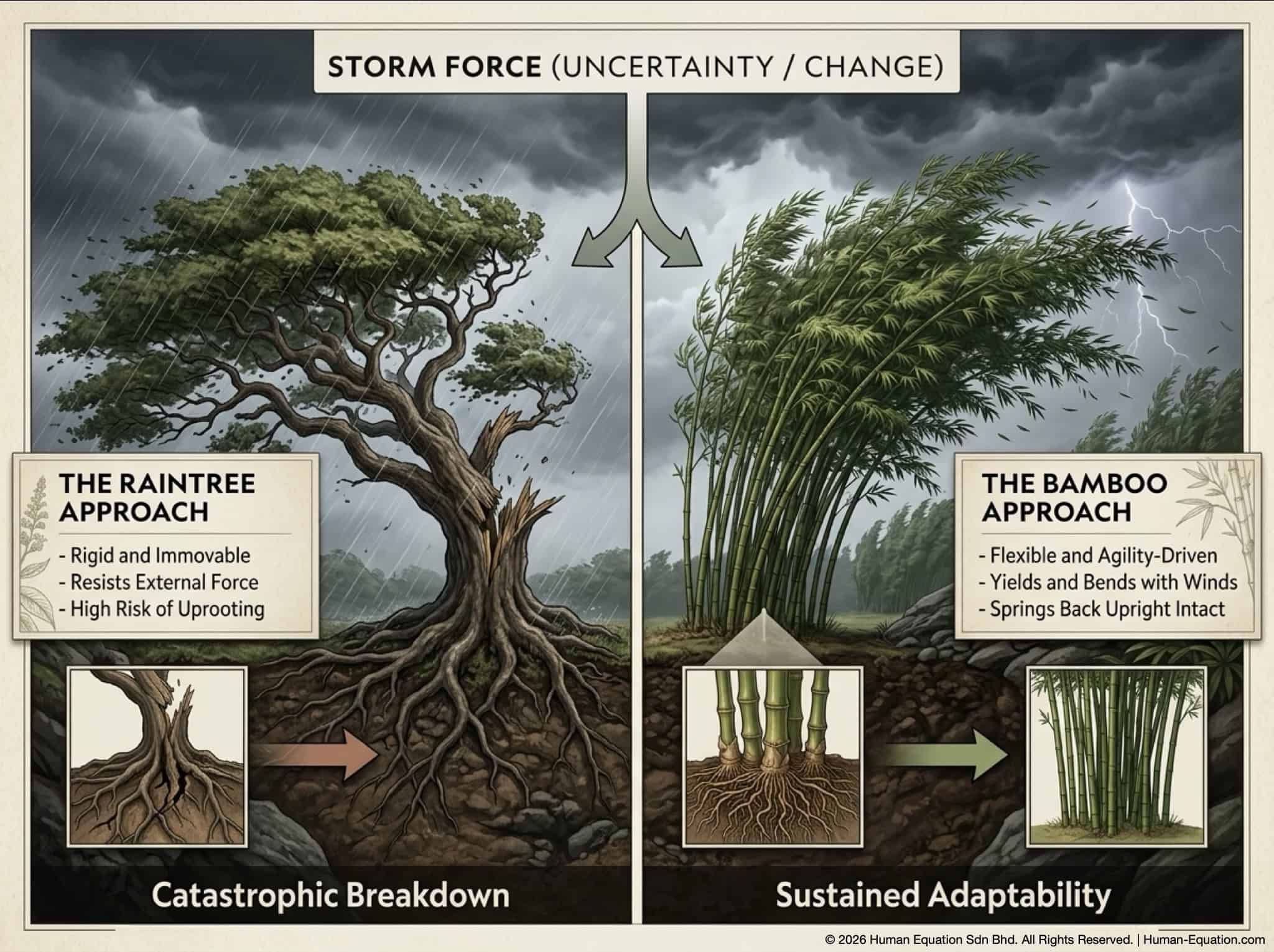
Can an unyielding raintree transform into an agile stalk of bamboo? Genetically, of course not. But allegorically and behaviourally, the answer is a resounding yes.
I can testify to this transformation personally. I was once a strict creature of habit—someone who felt sudden anxiety at the simple thought of moving house. Over time, I evolved into a purveyor of change, making mindset agility my life’s core work. Looking back on my journey, the shift from rigid security to purposeful movement continues to remind me of what is possible when we stop fighting the wind.
Core Strategies for Building Personal Resilience Through Career Pivots
Transforming into “bamboo” is rarely an overnight event. It is a deliberate practice of facing unfamiliar territory, making conscious choices, and trusting your capacity to learn.
1. The Courage to Outgrow Routine
For over a decade, I worked as a secondary school mathematics teacher. While I genuinely cherished my interaction with young minds, I felt constrained by the rigidity and routine of the environment. I craved deeper intellectual stimulation and personal growth.
Recognising that I needed to build a bridge towards new opportunities, I enrolled in night classes to study training management. Heavily pregnant with my second child, I braved evening city traffic twice a week, climbing flights of stairs and grappling with tight deadlines. At times, I wondered if it was foolish to prepare myself for an opportunity that had not even manifested yet. But preparing your mindset before the door opens is how agility begins.
2. Feeling the Fear and Acting Anyway
That opportunity arrived five years later. By then, I had been engaging in part-time property sales alongside my teaching role, having discovered a natural affinity for real estate when purchasing my own home. After a successful period selling properties, the agency owner offered me a full-time position as a recruitment and training manager.
I hesitated instantly. The fear of stepping away from a secure, familiar profession to enter an unfamiliar corporate sector felt overwhelming.
My defining moment arrived when I encountered Susan Jeffers’ classic insight: the belief that we must eliminate our fear before making life-changing decisions is a misconception. The only way to dissolve the fear of doing something new is to step forward and do it anyway.
Jeffers framed decision-making through a “No-Lose” lens: there are no inherently “wrong” decisions, only choices that yield different outcomes. Every choice offers a landscape for learning, growth, and refinement. If a decision does not deliver the result you sought, you simply adjust your sail and chart a new course. Armed with that perspective, I resigned from my teaching career and entered the corporate training space.
3. Embracing Uncharted Terrain
Two years into training, an unexpected door opened when an editor offered me a full-time role with a property publication. Though my writing experience up to that point consisted primarily of school essays, I felt an undeniable pull towards the challenge. Having successfully navigated one major career transition, I possessed the confidence to step directly into another.
That step launched a ten-year career in journalism. I moved from reporting on real estate to covering business, eventually joining a premier business weekly. It was a rewarding chapter filled with travel, high-level networking, and enriching experiences.
Yet, when an opportunity arose to re-enter the corporate sector to lead organisational development and eventually establish my own human capital consultancy, I chose to leave that comfort zone once more. Why? Because my deeper purpose lay in transforming lives and helping organisations build resilient cultures.
4. Pivoting When the Storm Hits
After running my own training consultancy for over twelve years had brought immense fulfilment and steady year-on-year growth. And then, the COVID-19 pandemic hit. Almost overnight, all face-to-face training came to a complete standstill, and my pipeline evaporated. My immediate reaction, quite naturally, was fear. But the habits of agility built over decades kicked in. Recognising that my operational model required immediate evolution, I immersed myself in learning—upskilling in design thinking, virtual facilitation, digital branding, and strategic storytelling.
The lesson was clear: when external realities shift, flexibility ensures that your core mission remains intact, even as your methods adapt.
Practical Lessons: How to Cultivate Your Bamboo Mindset
If you currently find yourself standing on the threshold of an unexpected change or a daunting career choice, consider these practical steps to build personal agility:
- Take One Step at a Time: When faced with a massive, unfamiliar landscape, focus solely on the immediate next step rather than trying to map out the entire mountain at once.
- Arm Yourself with Knowledge: Treat skill acquisition as an ongoing journey. Upskilling diminishes uncertainty and gives you tangible confidence when stepping into new arenas.
- Reframe Failure as Feedback: Adopt a “no-lose” perspective. If a pathway does not yield the outcome you anticipated, retrace your steps, extract the wisdom gained, and design a revised route forward.
- Acknowledge Fear, Then Move: Waiting for complete fearlessness before taking action leads to paralysis. Accept that fear is merely a natural byproduct of growth, feel it fully, and step forward regardless.
Frequently Asked Questions
What is the difference between rigid strength and resilient agility?
Rigid strength relies on remaining unyielding and immovable under pressure—much like a raintree resisting strong winds. Resilient agility, like bamboo, involves flexibility, adaptability, and the capacity to bend under intense pressure without breaking, allowing an individual or organisation to spring back once the challenge passes.
How does Susan Jeffers’ “No-Lose” decision framework work?
The “No-Lose” model suggests that there are no fundamentally wrong decisions in life or career pivots. Every choice leads to specific outcomes that provide valuable learning, experience, and opportunity for growth. If a decision does not produce the desired result, you simply re-evaluate and make a new choice.
How can professionals build career agility during times of industry disruption?
Professionals can build career agility by committing to continuous upskilling, diversifying their skill sets, cultivating a multi-hyphenate mindset, and actively seeking transferable applications for their existing expertise rather than relying on a single, fixed job identity.


