Freda: Good morning. This is Freda Liu, and of course, it’s the start of a brand new week. You’re listening to Enterprise. It’s also Raise Your Game, and we’re going to be talking about something that I’m sure affects all of us. Many of us have encountered so-called difficult people in our lives—people whom we allow to annoy us, upset us, demoralise us or generally make us feel negative in some way or other. Some faces come to mind now. Yet, what are difficult people really? Why is it we label them difficult, and why do we react so negatively to them and allow them to affect us and even torment us?
So today, we’ll be discussing How to Handle Difficult People with Sheila Singam, founder of Human Equation. Of course, she’s here the last Monday of every month, and she’ll be giving us some insight into how we define difficult people, what makes them difficult and how we can handle our relationships with them. She’ll be sharing some coaching case studies of how she used simple NLP tools to help her clients manage the challenges in relationships in their lives. So, Sheila, how do we define difficult people?
Sheila: Actually, what are difficult people? Freda, I always believe, and one of the basic premises of NLP is that you need to look beyond a person’s behaviour to who they are. A person is not their behaviour. So, instead of labelling them as “difficult people”, I might say “people who behave in a difficult manner”. So then you’re separating the person from the behaviour, right? So if you say “difficult people”, then you have a tendency to want to run away. But if you say that particular, certain behaviours of theirs are difficult, then there’s still hope for the relationship with the person, right?
So who—I mean, generally, what we do is we tend to label those people who are negative, who are constantly angry, who are constantly picking on us, who are never satisfied, so to speak, always speaking in raised tones, whom we allow to aggravate us—people who might be toxic, always got stuff going on and never satisfied with what life has to offer, right? People who put us down constantly for their own reasons. And I always tell people, “Don’t just dismiss the relationship, react and get upset.” Now, one of the things is that people and circumstances cannot affect us unless we allow them to.
This is a statement I always tell people in my trainings: “I can make you a cake. I can make you Nasi Lemak. I can make you a cocktail. I can’t make you angry.” I can say something, but at the end of the day, your choice to be angry is your choice, and how you react towards me. So, we need to first of all, before we start labelling people as difficult and treating them as such, we have got to examine ourselves.
Freda: Yeah, so that was the thing. Sometimes these situations always affect us when it’s the people closest to us or people that we have to have close contact with, because it’s easy to avoid or to just say, “I don’t see them all the time, so let it be.” And whenever you say that also, I think there is that space when someone annoys me, I always ask, “Why am I mad with this situation?” And then it comes back to me: “Is it me? Firstly, is it me?” And why is this statement made… join me, right?
Sheila: Good question to ask because one of the things that we need to realise is that we can’t change people. We can’t change circumstances. We can’t change the environment. I mean, we can to a certain extent. Your choice is to be a thermometer and measure what’s the temperature out there and then react to it, or your choice is to be a thermostat and determine what the temperature is out there, right?
So, my point is that you have got to examine yourself always and ask if you’re going about it the right way. We need to take charge of our own reactions, our own actions. Are we reactive people or are we proactive people? Because that’s the difference. That person came and said something not nice to me, so my choice is whether I want to get angry and let it stew in me and then sort of snap at the other person and start this war going on, or whether I’m going to say, “Well, that’s your opinion, and that’s on your head, and I don’t choose to take it on”. But very often, we choose to take on people’s stuff and what people throw at us.
Freda: Mm.
Sheila: And that’s the difference between a person operating at cause and a person operating at effect. A person operating at cause will decide, “Well, I’m not going to react to whatever is being said about me.” A person operating at effect will immediately just go and feel bad and feel small, and say, “Why are you saying this?” and they never examine themselves. So, whenever we’re doing programmes or coaching on managing so-called difficult relationships, and people come and whinge and complain about this person or that person, I say, “Well, ask yourself: what can you do to impact the relationship?”
Because, fundamental to all relationships and what’s happening in our lives is the precept of “perception is projection”. Whatever you hold inside of you is what you’re projecting. So, for example, let’s say, Freda, you don’t like someone and they’ve been so-called difficult—and I use inverted commas here—so you’re reacting to that. So when they perceive that, they’re reacting back, so you have this back-and-forth reaction going on. So then what happens? Some small, inane comment escalates into this huge conflict like, “I don’t want to talk to you, and you don’t want to talk to me.” And then, when you go back and examine, it was such a small thing. Why did that happen?
Freda: Why did it affect us so badly, right?
Sheila: It all has to do with one’s ego. It’s always that “I must win”. “How dare you say that about me and make me feel small?” But nobody can make you feel small; it’s your choice. If you have utmost confidence in who you are and your self-worth, then you are not going to have to feel small about what people say. Now, I can understand that happening to children when parents and teachers put them down, because they don’t have that analytical ability to be able to filter and say, “This is true,” and, “That’s not true.” Children think their parents speak the gospel truth, and their teacher knows everything. So they take on those beliefs, whatever people are saying about them. But as adults, if somebody came to you today, let’s say, Freda, and said, “Freda, you’re not beautiful,” I’m sure you’re not going to believe them. I mean, look at you!
Freda: It depends. I tell you, but again, and I get it and I’m old enough, but if it’s someone that’s close to me, right? It would…
Sheila: Yeah, but…
Freda: To a large extent.
Sheila: But like today, there was a time when I was young and people said this and that about me and my looks, and I’d be like, “So…” I had so much baggage that I carried, then I let it go. And today, it’s like, whatever. I am what I am at my age—grey hair and all—and I still think in my own way, it’s not about outward appearance, it’s about how beautiful I am inside. So, at the end of the day, you’ve got to sit down and take stock of yourself and examine yourself when people are saying things to you.
Now, coming back to difficult people, why they affect us so much is because if they’re very close to us, you tend to want people close to you to have this really good impression of you. But the truth of the matter is the people who are closest to you are the ones who see the real you, lah. The guard that you drop… you know, your outward facade when you go out, and then when you go home sometimes you just drop it, because it’s a bit tiring to keep it up for a long time, right? So, if you’re truly an authentic person, that means you are at home as you are outside and everywhere else, then you really won’t have that going on.
But at the end of the day, it’s the people closest to us because we love them, and we want to have value in their eyes. So, at any time if they’re critiquing us, and then we feel that our value or saham drop in their eyes, that’s a bit painful. It hurts a bit. So if you think you’re the most beautiful woman in the world to some guy, and then he comes and says, “Honey, I think you put on a few kilos there,” you’re like, “Oh my gosh!” So what? What’s the big deal about that? He’s like, “Oh no, nothing, there’s more of you to love.” But then it kind of sticks in you that he has said that, and then you start questioning, “Why is he saying that? What’s his point? Is there someone else out there who’s thinner than me, and he’s noticing this? How is this going to affect my relationship?” Oh my god, and then you get angry and your mind wanders.
Ah, so we all do this: we start conjecturing as to what he means. Someone can come and say something innocent, but having said that, out there people shouldn’t be coming in and saying, “Hey hello, I haven’t seen you for a long time, you’ve put on some weight.” I mean, is that all you can say after not seeing me for two years?
Freda: Okay, so what are some general principles to consider when dealing with difficult people?
Sheila: Okay, first of all, and this is what we call the forgiveness presupposition. You’ve got to ask yourself: what is behind that behaviour? Now, people don’t set out to be nasty. We just don’t want to go there and kill relationships and damage our working and personal relationships. So, I don’t deliberately go there and meet you on the street and say something nasty to you, right? But when people do that, they are reacting. They might be reacting to you, or they might be reacting to their own inner lack of self-esteem, lack of self-confidence. And you know what they say: “hurting people hurt other people,” because you’re projecting your hurt out there. You don’t want to be the only one to suffer sometimes.
So, remember this: behind someone’s behaviour is a human being, and sometimes that behaviour is a cry for attention. For example, you have someone who’s always yelling, throwing his weight around on you, doing this power stuff on you. Maybe the guy feels really small inside. So, by virtue of his position at work—for example, call it situational leadership—he’s got that clout over you. So, he throws it around because he doesn’t want you to see, maybe, that he’s really not that confident, or maybe not as good as you are at the job. So, he constantly puts you down. Now, it’s not right…
Freda: Oh, yeah.
Sheila: But what you do is, if you find out what is the intention behind that behaviour for that person. Everyone gets a positive intention for themselves for a behaviour. So if you can find out what that positive intention is and find another way to give them that positive intention, then you can actually change the behaviour. If you can find another behaviour which will give them the positive intention, it can actually change the behaviour. So, someone who is doing power stuff with you, if you’re constantly standing up to him and pitting your will against his, that’s just going to be a “no-no” in the relationship. But if you go around the way and say, “Okay, well, I have this idea. What do you think about it? I really value your input, and I’d really like to know what you think because, as my boss, your opinion is important to me…”
Freda: Right. And that’s not buttering up; that’s just—
Sheila: And that’s not buttering up; that is also giving that person the due respect of the position. In a way, you are helping that person to build up his self-esteem as well. Now, having said that, all of this does take effort, and it does take time. If you don’t want to do it, and then you’re sitting there and complaining, “Oh, my relationship is very difficult,” you’ve got to look at yourself. I’ve known people like that. They move from one job to another. “Everybody is victimising me. Poor me. Everyone treats me badly. Wherever I go and work, I don’t know why people are doing this to me.”
Now, I’ve had people come to me like that for coaching. One question I asked them: “Four jobs you went, and they all treated you like they putting are you? So, all those people, did they know each other? Did they pass the word around about how terrible you were?” “No, no, no. They didn’t know each other.” “So, what’s the common factor here?” And they went, “Me.” And then suddenly you can see the “aha” look on their faces. “You’re saying it’s me?” I said, “I’m not saying anything. What do you think?” And then they go, “It’s me.” I said, “Uh-huh. It’s what you’re projecting wherever you go. If you’re going to go there projecting that people are going to victimise me, then they’re going to do it.” Because people, many times, take on what you project about yourself.
Freda: Okay. Now, you talk about this positive intention. I’m sure, because we’re going to go through some case studies in just a moment, that kind of discussion will be brought up in these case studies. I’m here with Sheila Singam from Human Equation. We’re talking about handling difficult people. Stay tuned to Enterprise, BFM 89.9.
Spot Break: Bankers, financiers and money makers. BFM 89.9.
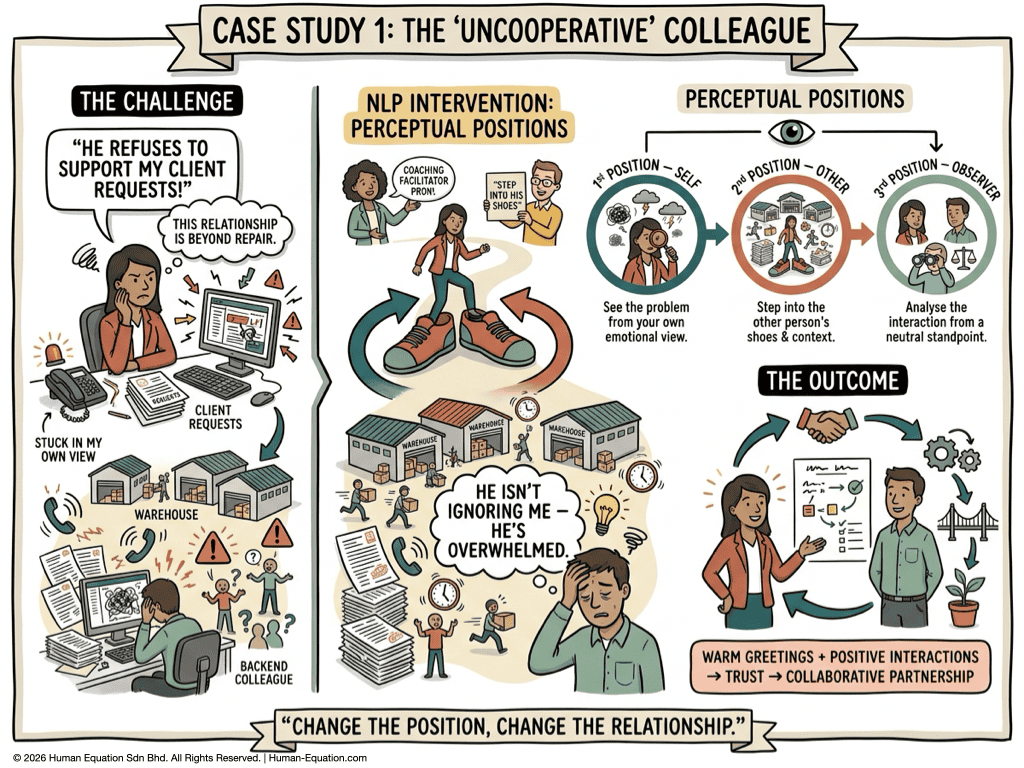
Freda: Good morning. This is Freda Liu. You’re listening to Enterprise’s Raise Your Game. Sheila Singam from Human Equation is here. She’s here every final Monday. We talk about handling difficult people, and I guess it’s a great way to start the week, as we meet lots of people along the way. Now, as usual, we’re going to discuss some case studies and how you use NLP tools to handle some difficult relationships. So, we’ll go through the first case study here. You had a client who had a poor relationship with a colleague. She claimed the colleague was not supporting her in managing her customer relationships, leading to her feeling stressed at work. She said she didn’t see how she could make any breakthrough in that relationship. So, how did you help her here?
Sheila: This was very interesting because I was giving her some concepts, and then she turned around and she said to me, “You know, Sheila, in theory, all that’s very good, but it cannot work. This relationship cannot work when you’re there, faced with the customers, and then your colleague is not giving you backup. All these theories don’t work.” I said, “Oh, really?” I said, “Okay, let’s see. Let’s do a little role play here.” So, I got her to do a role play. First of all, I gave her some NLP presuppositions that whatever—think about it: what are you projecting to this person? You’ve been projecting to this person that “you’re not cooperative, you’re not helping me.” And so, that person, and then your facial expression, your tonality and all that, it’s really being projected to that person. So, of course, and very often—here’s one thing, just a little sidetrack, Freda—we often forget our tonality and our physiology is so important in our interaction with people.
Some people are very, very responsive to tonality. So if you raise your voice, or your tone is harsh, or your words are harsh, they’re really going to react to that. And sometimes it’s your physiology—like I’m looking and talking to you when I’d rather be somewhere else—so people are going to read all these signals. So that’s one thing I said to her.
And number two, I said to her, “Look beyond the behaviour.” Possibly there are some reasons why this person is like this, who is not instantly, immediately responding within the minute to your requests. We did a role play where I got her to stand in his shoes to be doing his job, and I sort of pretended to be her. So, I went there demanding things from him, and slowly, it dawned on her that he is not just servicing her needs.
He’s backend support, giving backend support to customer service staff. He’s not just servicing her needs; he’s servicing the needs of five warehouses and numerous customer service staff, and everyone is screaming at him all the time. So, definitely, he’s going to be grumpy. He’s going to dissociate and be very remote from these people because it’s just too much to have ten or twenty people calling you and yelling at you, “Where’s my stuff? Where’s my stuff?”
So when she put herself into his shoes and sort of took on his role, you could see the “aha” moment.
Freda: From the guy’s perspective, it’s like, “I don’t need another person hounding me.”
Sheila: Yeah! So I said, “What have you learned from this, being in his shoes?” She said, “Now I see where he’s coming from. Now I know why all the time he’s so stressed and he’s so angry. And then when I go and lay it on thick again, that’s why he reacts to me the way he does to everyone else.” Because earlier on, she was like, “He’s like that with everyone.” And then I was like, “If everyone is behaving…” and she said, “Yeah, if everyone is behaving like me, no wonder he’s like that.” So I said, “Now, how can you change the relationship?” Because you’re not going to go and tell him, “Hey, you’d better change the way you’re dealing.” If you want to change a difficult relationship, if you want that relationship’s conflicts to be resolved and to have a relationship with that person, you need to take the initiative. Change always starts with us.
And that’s what Gandhi said: “Be the change you want to see.” Don’t be expecting everybody else to change the way they talk. You do it first, and then you will watch them react. I’ve seen this so many times. In the early days, when I had a preconceived notion about someone, I’d say, “No, Sheila, don’t judge. Look beyond the behaviour to the person, and just react wonderfully to that person.” And then suddenly you see, and everybody says, “How do you get along with that person?” I’m just applying these precepts, that’s all. So, she learned this, and she said, “Oh my God, it’s me. I have to change my tonality. I can see myself standing in front of him, very angry, shouting like that. No wonder he reacts like that to me.” I said, “Okay, so what are you going to do now?” She said, “When I go back to work, I’m going to try a different track. I’m going to actually go and be very pleasant with him. I’m just going to go there and greet him and not ask him anything.” “He’ll probably have a bit of a shock and wonder what’s wrong with me.” I said, “Yeah, he’ll probably think you’ve gone a bit off or something, right? Changing your behaviour.” She said, “But I’m going to do that.” I said, “Persistence. You do it the first time, people might not react. They might be suspicious the second time, third time. But if you keep on being nice to someone, at some point they will realise you don’t have an agenda and they’ll respond positively to you.” So, she said that she was going to go back and do that. And I could see in that session itself the physiology changed in her when she put herself into his shoes and realised what he was going through. You could see when she was talking about it, she was kind of choking at the fact that all this while she never knew that. So, she had a total turnaround about these concepts just being theories.
Freda: I think even the lesson learned—we hope that will help resolve it—but the lesson learned would be putting yourself in the other person’s shoes and actually physically acting it out sometimes, and saying, “Wow, this is what this person has to go through day in, day out.” Complaints from customers and complaints internally—wow. What’s my priority? Obviously, the customers in that sense, right?
Sheila: Yeah, that’s a good point, putting yourself into the other party’s shoes. I would advocate that number one in any relationship where you’ve got conflict or stuff going on. Always put yourself into the other person’s shoes, then maybe you’ll be able to see what is triggering that behaviour.
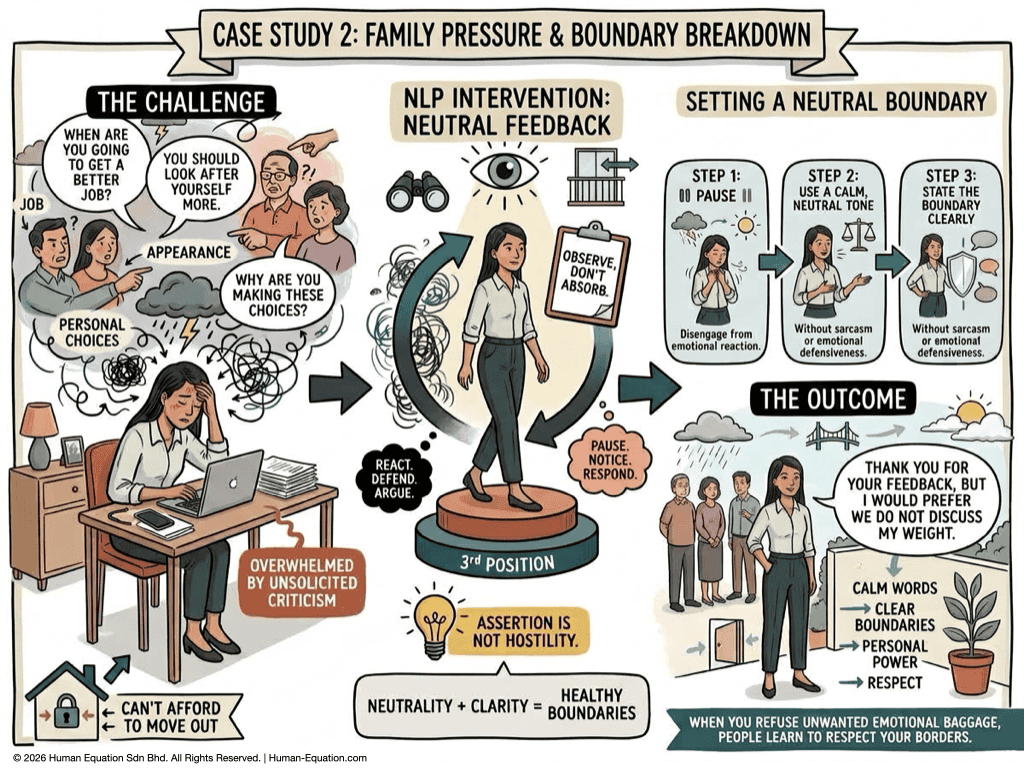
Freda: Walk a mile in my shoes. Right. Okay, here’s another one. A young lady came to see you about her anger at the constant criticism she received from her extended family members. They commented on her clothes, her hair, her mannerisms, her choice of job, friends—wow. So, she was getting extremely stressed and felt unable to cope with living with her family, but she couldn’t afford to move out. So, how did you help this person?
Sheila: One of the things that we forget to do as Asians—generally, I say this is more predominant in Asians—is we don’t know how to draw boundaries. We think that because we love someone, we just have to lay down, be doormats and take everything from other people. We let them pile it on once, two times, three times, then when it gets too much, we kind of crack up and have a bit of a blow-up. So, I think that from the minute someone encroaches into your territory or turf, you need to stand up and say, “Well, I don’t like that.” You need to be very assertive and say, “I don’t like that tonality. Please don’t speak to me in that tone, or please don’t say those things to me. I don’t take kindly to that. If I need your feedback, I will ask for it.”
It took me a long time to do that. I come from an Indian family; we are the most critical of each other. So, it took me a long time because we were all taught respect, especially respect for your elders and all that—don’t talk back. But you don’t have to talk back, you can speak up. So, I have begun to speak up. I have begun to speak up and say, “Well, I don’t think that’s right of you to say that,” or, “Is that all you can say?” Somebody kept saying to me, “You know everything. You just know everything.” I turned around and said to that person, “Thank you so much for saying that. I think it’s like a prophetic word that you have passed on to me, because I really feel that I’m getting better in terms of my knowledge and skills because you keep projecting that onto me. Thank you so much!” Then, what to do?
Freda: Okay, this is very interesting. The difference between talking back or speaking up right there—there’s a fine line, because my “speak up” would then include a sarcastic comment at the end, and it shouldn’t. So, the “speak up” must be very, very neutral.
Sheila: So, this is where, when I say you want to give feedback, you go into… remember we were talking about positions just now, stepping into the other person’s shoes? This one, you don’t step into their shoes. You step into neutral territory. So, you imagine yourself stepping out of your shoes, a neutral party observing this exchange, and going and saying, “Look, I don’t think that was right. I don’t think that was called for, what you said to that person. If you need to give feedback, you need to give it in a neutral, pleasant tone.” So, when you tell the person, “Every time you see me, you keep talking about how much weight I’ve put on or how much weight I’ve lost. What are your intentions?” or “What’s your objective of saying that?”
Then they say, “No, no, I’m just observing.” “Thank you very much, but I’d rather you didn’t.” I’ve learned to tell people that. Sometimes, people will come and complain to me about some other person. I’m like, “Okay, is there something you want me to do about this? You want me to go talk to that person?” “No, no, no, I’m just venting.” I’m like, “Yeah, but every time I see you, you’re venting about that person. I’d rather you didn’t. If you really need help in resolving the issue, come and see me and arrange a coaching session. But if I’m having tea with you, I don’t need to constantly be hearing you venting about the same person. I’m not a sounding board for all your angst, right?”
So, people get it, and I keep telling them, “If you keep on going on like this, I’m not going to have tea with you.” Then the next time they meet me, they start, and then they see my face. I’m like, “Talk to the hand,” and they’re like, “Okay, okay, okay. We’ll just talk about other things.” So, you need to set the boundaries about what is acceptable and what is not acceptable. For example, my daughters—we are all brought up in the way that we need to respect our elders, but sometimes they come and say to me, “So-and-so, this auntie said this, or that auntie said that, and it’s really annoying.” I say, “Well, use a good tonality, be very polite and give them the feedback.” And if they want to say anything about it, then they have got to take it on that they need to learn what their boundaries are when they want to trespass into somebody else’s life.
Freda: Okay. All right, we’re going to go through one more case study after this. I’m here with Sheila Singam from Human Equation discussing how we can handle difficult people. Stay tuned to BFM 89.9.
Spot Break: Barcelona, Fiorentina, Manchester United. BFM 89.9.
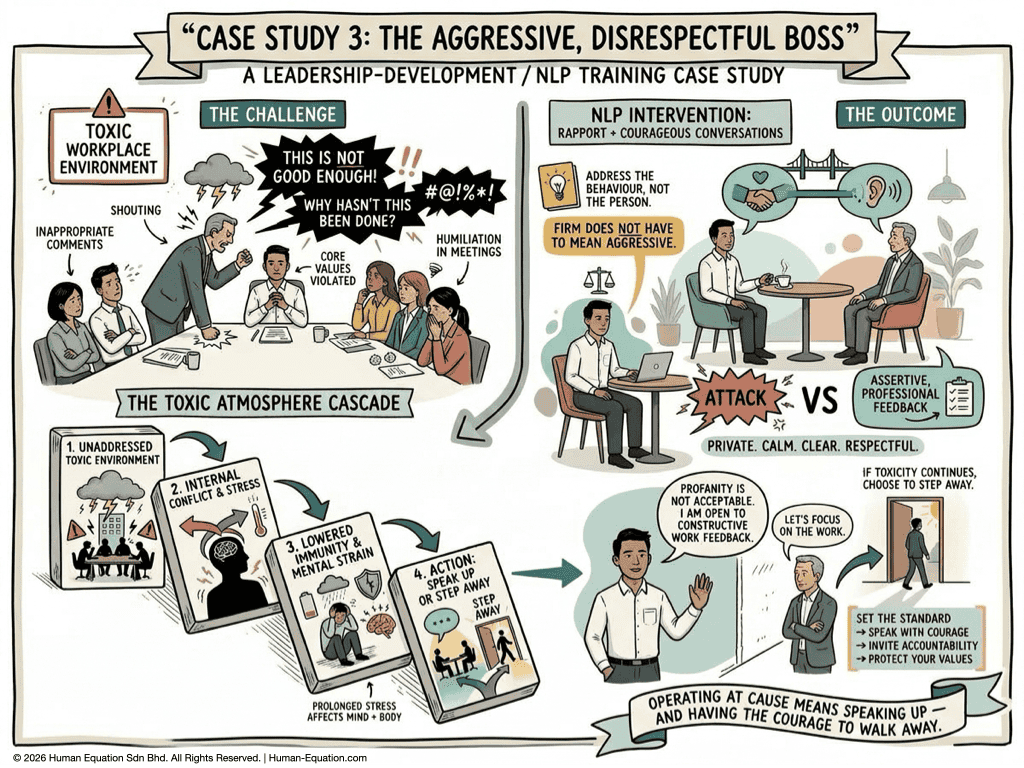
Freda: You’re still listening to Enterprise. This is Raise Your Game. Sheila Singam from Human Equation is here. We’re talking about handling difficult people. Of course, Sheila is here on the final Monday of every month. We’ve gone through two case studies earlier on, and these are people that you’ve coached in real-life situations. I think we’ve all experienced them at one stage or another. Here’s another one: an executive had issues with his boss’s manner of communication, which he felt was disrespectful. His boss would shout profanities at people, make inappropriate jokes about his staff, put them down at meetings and so on. Such behaviour conflicted with the executive’s values, and he felt extremely uncomfortable working there. How did you coach him?
Sheila: Well, here’s the thing that many executives find difficult to accept: that they need to stand up and tell colleagues and bosses how they can and cannot talk, or communicate and not communicate. In my own personal example, I had a colleague who used to send emails containing inappropriate material—explicit, sexually explicit material. I told him to stop it, and he still kept sending it, so I just blocked him. We need to learn to talk to people like this. So, in this instance, we advised the person to have that difficult conversation: to take the boss out and talk to the boss about the boundaries, and how, as a person, his values were being invaded by this sort of talk and conversation, and to actually tell the boss not to do it.
Freda: Okay, and I guess if the boss owns the company, it’s a bit difficult. But if not, isn’t this something that HR can handle?
Sheila: I had a situation which was similar, so I knew how to handle this. I had a boss who would shout four-letter words at people at meetings. So one day, I just went up to him and said, “If you ever have a question or you don’t like an idea of mine, hold me up quietly and talk to me about it, or talk to me about it in public, but don’t ever use a four-letter word with me, because I will get up and I will leave.” And he never did it with me. He still did it with other people, but never did it with me.
So, that’s the thing. Whoever it is, however high up in the company or wherever, if you allow people to behave to you in a certain way, it’s you allowing them. So, the first step of recourse is to speak up. Speak up. You have to have the courage to speak up. You have to have the courage of your convictions. Now, if your values are your deepest driver, they are very important to you. If someone is violating your values, then you have to speak up. Yes, that person might persecute you, but then you need to be the person to have the courage to stand up to face the consequences. In this instance, I asked him which values were being violated, and I told him that if you do not address it, then you’re going to be more and more uncomfortable. The conflict is going to grow, and you’re going to be projecting that as well, and you’re going to be more and more unhappy inside. Unfulfilled values is really a bad place to be in.
So, either you change your value system to say that it’s okay for people to use words like that—which you don’t want to do because of your convictions—or you need to speak up and have a one-on-one conversation and say, “Boss, I’m really open to your feedback. You can say anything you want to me, but the profanities… there are women there and it’s really inappropriate.” I hope, of course, if the boss can take the feedback, that’s great, but you need to be in rapport. So before you do this, don’t barge into his office and say this. Say to him, “Could we go out for a cup of coffee? I want to talk to you about something I’m really uncomfortable about,” and have a chat with him. Of course, the boss might turn around and say, “Hey, but this is who I am. You accept me or not.” Say, “Yeah, well, I’m finding it hard to accept.”
This is the thing I always tell people: you can’t go around telling people, “This is who I am. Accept me or not.” Then when people don’t want to accept you, you whinge and complain. So, at the end of the day, if people are not able to accept your behaviour, then you need to change your behaviour. On the other side of the spectrum, if you cannot accept someone’s behaviour, you have to speak up and tell that person that this is unacceptable behaviour. Now, what is unacceptable behaviour? Behaviour that’s not ecological, behaviour that’s really harming people or harming the environment. A shouting boss who is shouting bad words in the office is really bad for the atmosphere of the office, right? I mean, I can just imagine it becomes so toxic. So, one thing you need to do if you are there and the atmosphere is toxic is to be the person to man up and see whether you can put a stop to it. And if you can’t, then you make a decision whether you want to stay there or not. But bear in mind, when you are in a toxic environment and you don’t attempt to clean it up, it’s going to get more toxic, and then it’s going to filter into your psyche. It’s like being in a radioactive, toxic pond. What’s going to happen in the long run? And believe me, being in a radioactive, toxic pond is the same as being in a toxic environment because it is going to affect your health…
Freda: Right? Okay.
Sheila: Because when your emotions are not in balance, what is disease? It is dis-ease. So when you are not at ease, then your immunity gets lowered, then you get unwell psychologically. You’re unhappy, you have issues, and your body gets unwell. So, I always believe: stand up, man up, and—
Freda: Woman up.
Sheila: Woman up, yes. You don’t have to confront the person; you can do it in a place of rapport, right? And if the person wants to accept it, great. Then you have managed to be a thermostat.
Freda: And I guess, in this case, where you say you’re a thermostat, you come from a point of good intention.
Sheila: Yes.
Freda: You come from a point of… and I guess, from all this, it’s about speaking up. And speaking up doesn’t mean fighting back or talking back, but just addressing the situation. There’s a time and place to be in that person’s shoes, and a time and place to be in a neutral position.
Sheila: That’s right. So if you want to understand, to summarise a bit: first, before you approach that difficult person, take a minute to step into his or her shoes to see where they’re coming from so you understand what their motivations and intentions are. Then, when you need to go and give them feedback, you step into a neutral position. So you’re not doing it in your shoes, with your emotions and all your baggage coming to bear on that conversation. You’re in a neutral position, giving the person very neutral feedback in a very non-threatening way, with the right neutral tonality. And it can be done. I do it all the time.
Freda: All right. Thanks for being with us, Sheila Singam, talking from Human Equation about this very interesting topic: Handling Difficult People. Of course, you’ve been listening to Raise Your Game on Enterprise. The next song is quite appropriate, actually: Rod Stewart, “I Was Only Joking”. BFM 89.9.
Closing Spot Break: Thank you for listening to this podcast. To find more great interviews, go to bfm.my or find us on iTunes. BFM 89.9, the business station.