


Originally written by Sheila Singam and published in The Star in September 2022 as “Assuaging the Hungry Mind”, this adapted article on conscious sustainability in business explores how quietening the “hungry mind” concept through spiritual practices and mindful leadership enables professionals to transcend perpetual corporate overdrive, avoid burnout, and foster long-term, sustainable balance.
Integrating inner awareness and simple reflective practices into corporate culture is no longer just a personal wellness choice—it is the key to sustainable business growth and human leadership.
Key Takeaways
- Shift Beyond Metric Compliance: True corporate sustainability requires moving past superficial ESG reporting toward an authentic internal mindset shift in leadership.
- Lead via the “Inner Reset”: Leaders must cultivate self-awareness and emotional regulation to replace burnout and reactive decision-making with long-term strategic clarity.
- Align Culture with Purpose: Organisational resilience thrives when executive values directly align with daily workplace culture and ethical stakeholder engagement.
- Embrace Systemic Stewardship: View business success as deeply interconnected with social and environmental well-being rather than short-term profit isolation.
- Model Conscious Resilience: Prioritise psychological safety and executive wellness to inspire sustainable performance across all tiers of the organisation.
Most of us know the quiet weight of the corporate grind all too well.
We move relentlessly from one meeting to the next, swept up in an unwritten culture that glorifies constant hustle, ever-expanding targets, and perpetual busyness. We check emails late into the evening, run on caffeine, and call it high performance. Yet, when we finally catch our breath, the invisible cost of this non-stop momentum becomes impossible to ignore. In our pursuit of immediate results, we quietly sacrifice our long-term well-being and the genuine sustainability of our teams.
Like many driven professionals, I must admit that I have had periods where I was caught up in this “disease of excess”—buying into the idea that we must always do more, acquire more, and move faster. But when leaders operate in a perpetual state of overdrive, the human element in strategy completely breaks down.
Philosopher and author Sri Preethaji highlighted this dynamic brilliantly during a talk on conscious sustainability in business at the Asia School of Business. She explained that our endless urge for more stems from what she terms the hungry mind concept—an internal state that has lost the art of resting once it is satisfied.
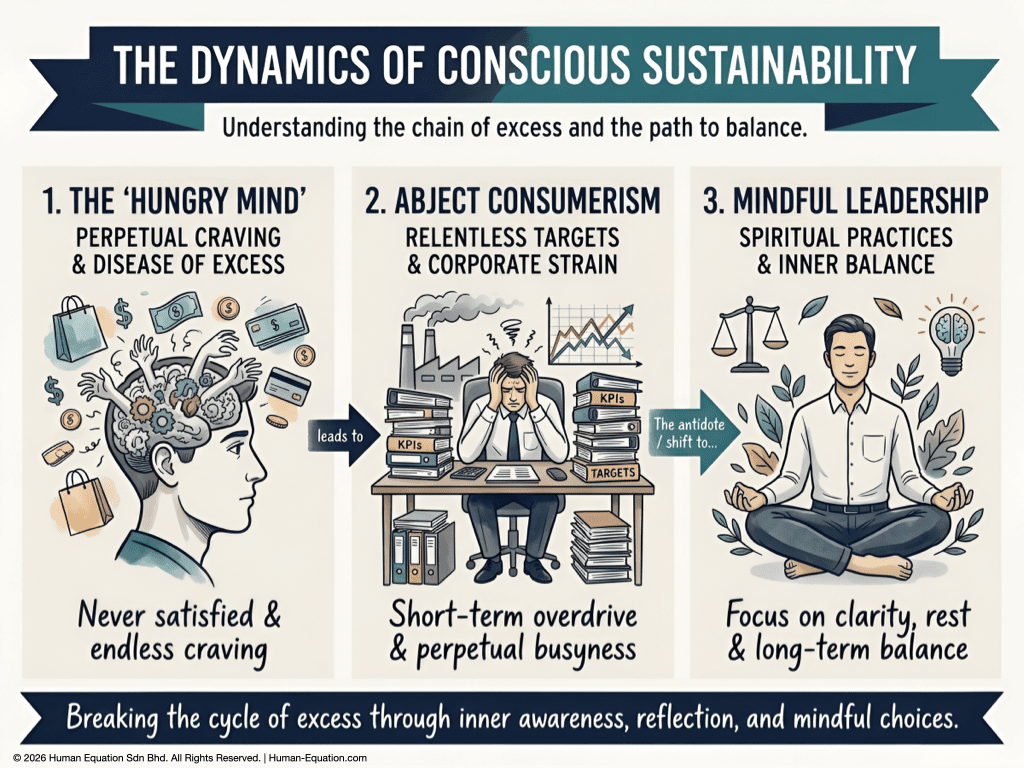
Most life forms observe a natural principle when it comes to sustaining themselves: hunger triggers a search for food, and once satiated, they stop and rest. The human mind, however, frequently ignores this balance. Instead, it continuously craves more—more power, wealth, status, and material possessions.
In corporate life, this unmanaged hungry mind drives the abject consumerism of our times, leading directly to executive burnout, strained team dynamics, and shortsighted decision-making. When we are disconnected from our own internal state, we naturally become disconnected from our people, our environment, and our broader sustainable business practices.
The solution lies in introducing spiritual practices in business directly into mainstream leadership. When I talk about spiritual practices, I am not referring to religion. I am talking about practical techniques—mindfulness exercises, positive affirmations, visioning, meditation, and journaling—that dissolve stress, bring focus, and elevate inner awareness.
Many successful leaders quietly use these techniques in their personal routines to stay grounded, yet hesitate to bring them into the workplace. I’ve always wondered about this. If we equip our people with technical and soft skills to do their jobs, can we not also equip them with the tools of mindful leadership to become beings with a higher consciousness?
Bringing Inner Awareness into Daily Execution
If we want to assuage the pangs of the hungry mind and achieve true conscious sustainability in business, we can begin normalising simple, practical reflective tools within our corporate routines:
- Incorporate Guided Mindfulness Exercises: Start key management meetings or high-stress strategy sessions with brief mindfulness exercises or quiet focus intervals to move the team out of a reactive, stressed state and into a place of clarity and efficiency.
- Practice Structured Journaling & Reflection: Encourage leaders and team members to use journaling as an analytical tool to examine daily stressors, process emotional reactions, and gain clarity before making critical business decisions.
- Deploy Positive Affirmations and Visioning: Integrate clear visioning exercises into team goal-setting so that targets are driven by long-term purpose and shared fulfilment rather than short-term panic.
- Normalise Rest & Satiation Signals: Actively counteract the “disease of excess” by establishing clear boundaries around constant connectivity, allowing teams space to rest and reset once key outcomes are achieved.
Frequently Asked Questions
What is conscious sustainability in business?
Conscious sustainability in business is the practice of aligning a company’s operational and growth strategies with the internal well-being and mindset of its people. Unlike traditional sustainability models that focus strictly on environmental or ESG metrics, it addresses the human root of corporate overdrive. Under mindful leadership, businesses learn to quiet the relentless “hungry mind” and establish sustainable practices that foster organisational resilience without burning out their teams
How do you overcome the “hungry mind concept” in mindful leadership?
To overcome the “hungry mind concept”—which drives the constant, unmanaged craving for more power, status, and material output—leaders must introduce intentional “satiation” practices into their corporate routines. Mindful leadership shifts a team from a state of reactive panic to focused clarity by:
- Creating clear, non-negotiable boundaries around rest to prevent burnout
- Starting meetings with brief mindfulness exercises to reset focus.
- Using structured reflection or journaling to audit workloads and eliminate low-value busyness.
Why are spiritual practices in business important for modern organisations?
Spiritual practices in business are not religious; rather, they are practical, secular techniques like mindfulness, meditation, journaling, and visioning that help professionals manage stress and cultivate inner awareness. When normalised within corporate culture, these practices help assuage the chronic mental fatigue and daily anxieties of high-pressure work, enabling teams to operate with greater emotional intelligence, focus, and strategic clarity.
How does abject consumerism impact corporate culture and burnout?
Abject consumerism and the “disease of excess” create an unsustainable corporate culture by fostering a belief that success requires relentless, back-to-back targets and constant hustle without pausing to rest. When a business operates strictly on this “always-on” overdrive, it leads to widespread executive burnout, high staff turnover, and short-sighted decision-making. Breaking this cycle requires leaders to reset their organisational maps and adopt mindful leadership strategies that prioritise the human element of performance.
What is the difference between traditional business sustainability and conscious sustainability?
Traditional business sustainability typically focuses on external and environmental factors, such as resource management, carbon footprints, and supply chain compliance. Conscious sustainability, on the other hand, starts from within. It addresses the internal well-being, mindsets, and awareness of the leaders and employees who drive those external strategies, recognising that a business cannot truly be sustainable outwardly if its people are burning out inwardly.


