

How High Performers Overcome Limiting Beliefs with NLP in Work and Life

How High Performers Overcome Limiting Beliefs with NLP in Work and Life

Originally broadcast on BFM 89.9 – The Business Station: 🎙️ Listen to the Full Conversation: Sheila Singam discusses How High Performers Overcome Limiting Beliefs with NLP in Work and Life on BFM 89.9’s Tools for Transformation podcast with Freda Liu. (Run time: 18:40 mins). Published on 30 September 2016.

Have you ever wondered why so many talented, driven individuals hit an invisible ceiling in their careers or personal lives? More often than not, it isn’t a lack of effort or technical skill holding them back; it is the quiet, unspoken limiting beliefs running in the background of their minds.

In this article, I want to unpack how practical Neuro-Linguistic Programming (NLP) tools can dismantle these internal barriers, transform our communication, and reframe our mindsets. To show you how this works in the real world, we will look at two remarkable case studies:

First, a technically brilliant manager whose team completely froze her out—and how a simple shift in her internal map turned resistance into genuine trust;

Second, a high-achieving professional trapped in a deep cycle of guilt and self-doubt over family planning, who completely transformed her physical reality once she broke free from her limiting beliefs.

Whether you are navigating tough team dynamics or battling unseen personal roadblocks, shifting your mindset can unlock extraordinary results in work and life.

Key Takeaways
  • Identify Subconscious Mental Blocks: High performers leverage Neuro-Linguistic Programming (NLP) to uncover hidden inner narratives and self-imposed ceilings that impede growth.
  • Master Cognitive Reframing: By shifting linguistic patterns and internal dialogue, individuals transform self-doubt into constructive, action-orientated mindsets.
  • Utilise Resource Anchoring: NLP techniques enable leaders to trigger grounded, confident mental states on demand during high-stakes work and personal situations.
  • Rewire Behavioral Patterns: Replacing automatic reactive habits with intentional neuro-sensory responses fosters long-term emotional resilience and career adaptability.
  • Sustain Peak Performance: Overcoming limiting beliefs allows professionals to achieve high-level goals without sacrificing mental well-being or work-life harmony.

NLP Case Study 1: A Young Manager’s Ivory Tower Trap
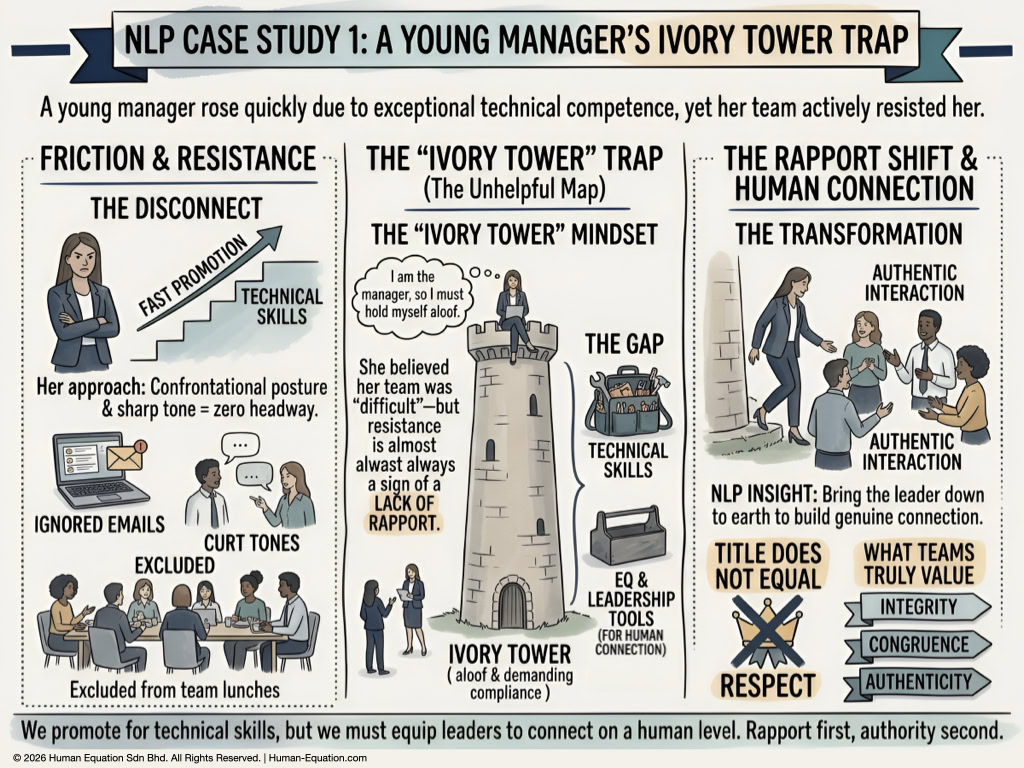
A young manager came to me after rising quickly through the ranks due to her exceptional technical competence. Yet, despite her expertise, her team actively resisted her.

They ignored her emails, responded in curt tones, and excluded her from team lunches. Her posture was confrontational, her tone was sharp, and she was making zero headway.

She believed her team was simply being difficult. But when we unpack workplace friction, we quickly learn that resistance is rarely about the other party—it is almost always a sign of a lack of rapport.

We promoted her for her technical skills without giving her the essential EQ and leadership tools required to lead human beings. She was operating under an unhelpful internal map: “I am the manager, so I must hold myself aloof, sit in my ivory tower, and demand compliance.”

Younger teams do not care about your job title; they care about your integrity, your congruence, and how authentically you interact with them.

Keys to Overcome Limiting Beliefs with NLP: Shifting the Internal Map

To turn her situation around, we introduced four fundamental success beliefs from Neuro-Linguistic Programming (NLP):

  • Resistance is a sign of lack of rapport: If people resist you, you have not taken the time to connect with them.
  • Perception is projection: What you hold inside your mind is precisely what you project outward to others.
  • The meaning of your communication is the response you get: Never assume people receive your words the way you intended; everyone listens through their own filters.
  • You are in charge of your mind and therefore your results: You hold total ownership over the thoughts and beliefs that drive your external outcomes.

We guided her through an exercise called Perceptual Positions. We asked her to step out of her own body and view her interactions from a neutral third-party perspective.

Looking back at herself, she finally saw the unapproachable, “holier-than-thou” stance she was projecting. When she stepped into her team’s shoes, she realised how alienating it felt to have a former peer suddenly pull rank.

She immediately adjusted her posture, learned to match and mirror communication styles, and began inviting team members out for casual one-on-one chats with no hidden work agenda. Once she shifted her internal state, the wall of resistance melted away

NLP Transformation Framework
Workplace Challenge Invisible Limiting Belief The NLP Breakthrough Tool Practical Outcome
Team Isolation & Resistance “I am the manager, so people must follow my title and hierarchy.” Perceptual Positions & Rapport Matching Step outside yourself to observe your tone, match communication styles, and build genuine rapport.
Personal & Career Stagnation “My failure is genetically predetermined or caused by external factors.” Dismantling Limiting Beliefs & State Management Separate physical facts from mental assumptions, drop unproductive guilt, and focus on well-formed outcomes.

NLP Case Study 2: When Limiting Beliefs Sabotage Personal Life
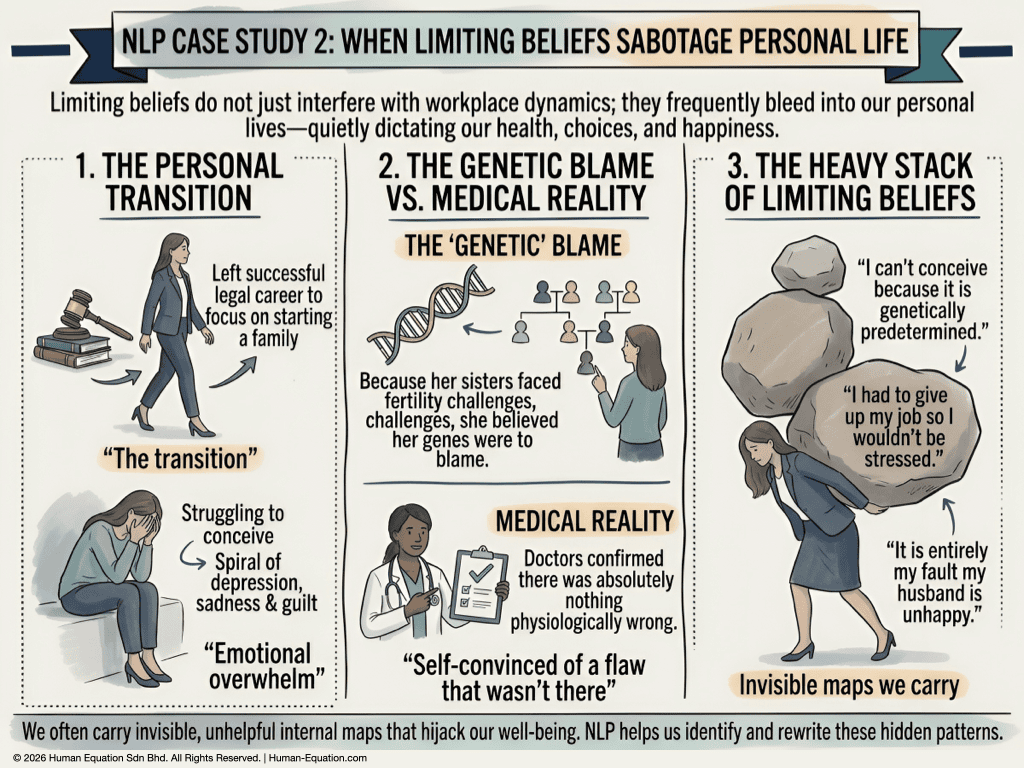
Limiting beliefs do not just interfere with our workplace dynamics and team relationships; they frequently bleed into our personal lives, quietly dictating our health, our choices, and our happiness.

I remember coaching a client who had made the difficult decision to leave her legal career. She and her husband, who was also a lawyer, had decided to focus entirely on starting a family. When she struggled to conceive, she fell into deep depression, sadness, and overwhelming guilt.

She had convinced herself that she was genetically flawed. Because her sisters had experienced similar fertility challenges, she firmly believed her genes were to blame. Yet, when she went for medical check-ups, her doctors confirmed there was absolutely nothing physiologically wrong with her.

When we sat down together, it became clear she was carrying a heavy stack of invisible limiting beliefs:

  • “I can’t conceive because it is genetically predetermined.”
  • “I had to give up my job so I wouldn’t be stressed.”
  • “It is entirely my fault my husband is unhappy.”

Keys to Overcome Limiting Beliefs with NLP: Dismantling Unproductive Guilt

Whenever a client comes to me weighed down by guilt, my very first step is to help them remove it entirely. Guilt is an extraordinarily unproductive emotion. Fear and anger can keep us safe in a fight-or-flight situation, but guilt simply keeps us trapped in past regret.

By systematically dismantling her limiting beliefs, we began to ground her mindset in clinical facts. Her doctor had confirmed her body was in perfect working order, making it clear there was no reason to hold onto a narrative that said otherwise.

Next, our focus shifted toward tackling her underlying assumptions about her career and marriage. Sharing stories of successful women who managed fulfilling careers while raising healthy families allowed us to plant fresh, empowering beliefs in their place.

Most importantly, we addressed her “mind-reading”. She had convinced herself that her husband was deeply unhappy with her because he wanted a son to play soccer with. We do this all the time, don’t we? We project our own anxieties onto others and assume we know what they are thinking.

I gave her state management tools to rediscover excitement, cleared her mind of self-imposed pressure, and encouraged her to have an open, honest dialogue with her husband. Once she let go of the guilt and took back control of her mind, she felt empowered to return to work.

Shortly after shifting her internal map and releasing that emotional weight, her physical state responded—she successfully conceived and is now expecting her baby.

“The mind is where it all starts—your health, your career, and your relationships. Clear the mental clutter, and your reality will quickly follow suit.”

If this dynamic sounds familiar to what you or your team are navigating right now, let’s chat. Send a quick message to our team at Human Equation, and let’s explore how practical NLP tools can help you reset your internal map and bring the human element back into your leadership. Click here to view our NLP Programme.


Frequently Asked Questions

What are the most effective NLP tools to overcome limiting beliefs with NLP?

The most effective tools include using Perceptual Positions to view conflicts objectively and applying pattern interrupts to break negative thought cycles. You can also apply NLP presuppositions—such as “perception is projection”—to take full ownership of your internal state and daily results.

How does matching and mirroring help build rapport in business communication?

Matching and mirroring physically, tonally, or linguistically creates a subtle, subconscious sense of familiarity and trust. When you reflect a person’s pace, tone, or key vocabulary, their defensive barriers lower, making collaborative communication far easier.

How do internal mindsets impact physical performance and well-being?

The mind directly influences physical well-being and performance outcomes. Holding onto chronic stress, assumptions, or unproductive guilt projects negative signals that impact how we interact with others and how our body functions under pressure.

How High Performers Overcome Limiting Beliefs with NLP in Work and Life

Programme: Raise Your Game: Tools for Transformation Series

Station: BFM 89.9

Host: Freda Liu

Guest: Sheila Singam (Founder of Human Equation)

Freda: Good morning. This is Freda Liu it’s Raise Your Game. It’s the final Friday of the month already. Sheila Singam from Human Equation is here in our Tools for Transformation series. Of course, what we do is we review real-life cases of situations and go through this process of NLP and how to go through it as well. And these are very real situations, right? It’s probably people you’ve met and you cannot put a name down.

Sheila: Oh no, yeah. It’s people I’ve met, people I’ve spoken to casually. Sometimes people come to me for coaching, and I do have their permission to sort of talk about the success stories. Some of them let me use their names and pictures. Some of them say we’d rather not, and I respect that. So that’s why there are no names mentioned.

Freda: Okay, so these are, of course, work-related situations. In this first case, a manager could not get along with her team. They either ignored her emails or replied to them in a curt manner. They never invited her to go for meals or breaks. Her body language and voice tone were very confrontational, and she was making no headway with them. So how did you handle that, or how can someone handle that? Because you hear these situations, you hear of friends. I’m just thinking whether I’ve experienced it—not really, but there are moments maybe you came into this team that was already there and you’re suddenly this new manager, and you’re trying to get to know these people as well.

Sheila: Freda, you said something that was very telling. You said you probably never encountered situations like this. A lot of times, our communication is to do with what we are projecting. You come across as being really very friendly, very warm, and likely that’s why people respond to you accordingly. It’s very hard, if you’re warm and friendly, to have someone respond to you in a very negative or rough way, unless they’ve got some issues that need to be sorted out.

Freda: See, it’s never others; it’s always self.

Sheila: It’s always self.

Freda: I hate that.

Sheila: I know, I hate that too. But the reality of it is, as my husband and business partner KP Warren always says, you cannot change the 8 billion people—is it 8 billion? You cannot change 8 billion people in the world.

Freda: Yeah, or 7 billion.

Sheila: But you can just change yourself, right? So what we did with this manager: first of all, she had risen up from the ranks because of technical competencies. And that’s another story—you promote people because of technical competencies without giving them EQ skills, managerial, and leadership skills, and just expect them to wade right in and lead a team.

Freda: Just because you were good in sales doesn’t make you a good sales manager.

Sheila: Absolutely. And I found that when people come to me for coaching. So what we did with this young manager was we started her off with some what we call presuppositions of NLP, or I can rephrase that as success beliefs. 

Number one: resistance is a sign of lack of rapport. So if people are resisting you, it’s because you haven’t taken the time to build rapport. Now, if you want to sell ideas, if you want to get people to cooperate with you, you need to be in rapport with them. All right? 

Number two: perception is projection. What you have inside your head is what you’re projecting out. So if I have negative thoughts about my people, that’s what I’m projecting out. If I have negative thoughts about myself and my capabilities as a manager, that’s what I’m projecting out. So what you send out is what you get back, in a sense. 

The next thing is: the meaning of your communication is the response you get. So basically, don’t assume that just because you have given instructions the way you want, people have received it the way you want them to receive it, because everyone’s got filters. So what you’re saying goes through their filters. 

And finally, the fourth one is that you are in charge of your mind and therefore your results. So whatever you’re putting in your mind, whatever you’re thinking, whatever beliefs you hold, they’re all going to be impacting the results you get in your life. So, first of all, we gave her these presuppositions of NLP to get her to loosen her map of the world, so to speak, those things that she holds in her head—

Freda: For example?

Sheila: Those things are like, for example, “I’m a manager and I’ve got to hold myself aloof, stand up there in my ivory tower, and everybody has to come down and do what I say” kind of thing. In today’s world, it doesn’t work like that. Especially when you’re working with young people, they don’t care. They don’t care about your title; they care about you and how much integrity you have, how congruent you are, and how you can interact with them. Young people respond very well to rapport. You build rapport with them, you get the maximum out of them. 

Okay, so the next thing we did was to use what we call the perceptual positions exercise, where we take her out of her shoes and into what we call a neutral third position. We let her look at her own interaction, so she’s up there as if she’s someone else, a third party looking at her own interactions and examining her own facial expression, her tonality, the words that she’s using, her gestures, and her posture. And she actually went out there and kind of looked at herself and said, “Ah, yes, I’ve got that remote—”

Freda: “—holier-than-thou.”

Sheila: Ah, holier-than-thou, unapproachable, “I’m the manager, so you listen to me” kind of attitude. So when she saw that, and then I got her to step into the shoes of her people… Here is someone who was a colleague, and then she’s promoted, and now she’s pulling rank on us. She forgets that we were buddies. She’s still a manager, we take instructions from her, but still, you don’t have to suddenly get into this persona—

Freda: The manager persona.

Sheila: Manager persona like that. Then after that, we gave her some rapport-building skills. We taught her how to match and mirror physically, and then also in terms of tonality. We taught her to identify what could be the preferred communication styles of her people. Some people like you to send them emails. Some people like you to go and pat them on the shoulder and talk to them and tell them. Some people respond well to contact—a pat on the shoulder, so to speak. Some people don’t like that. So you also accordingly adjust. If you’re the “hail fellow well met” kind of person, go pat people on the back—

Freda: Like KP Warren.

Sheila: Ah, like KP Warren. It can be very threatening to a person who does not like that kind of thing. So you need to actually, as we say, adapt your communication style to suit the other person’s. And then finally, of course, then we also got her to find out… Just go up to them, have chats, find out what are their common interests, and then talk to them about it. And we got her to invite the members of the team out one-on-one for chats, to say, “Look, I want to have a meeting with you. Let’s go for lunch,” and then just talk about casual stuff. Then the employee says, “I thought we were having a meeting.” “No, I just thought we’d have lunch. We’ll have the meeting another time; we’re having so much fun.” So you start building rapport in different ways. 

Freda: I met this CEO of a company, and what he did with all his senior management is they have fun together. They go for… I met them at the UB40 concert. Wherever there’s fun stuff, and he says, “I want all the senior managers to be friends, because when you’re friends, you work better together.” So it’s just simple things like that that you make a point to just do, and it’s something completely out of work.

Now, I have this thing, though: when I was working in my previous job, I had a regional role, and a lot of my communication was not face-to-face. A lot of it was on the phone and language.

So I found that very challenging. I mean, I can try to have a friendly voice, da da, then you think, “Okay, better speak slowly, they don’t understand me”. And then when I communicate via email, am I communicating warmly? We have this internal chat thing as well, so you try to be friends as much as possible. These are some of the things that I can do without being able to meet someone physically face-to-face.

Sheila: Yeah, that’s true also. Here’s the thing, though: when we talk about matching tonality and things like that, when you start off a conversation and someone is sort of very brass and a bit remote, and you start off all friendly, there’s a mismatch, you see. So what you need to do is start off by matching that tonality—not being cold, being polite and sincere, but—

Freda: “Hello, how are you?”

Sheila: Yes, “How are you? So if they are very crisp and professional, you also take on that crisp and professional stance, so that actually helps to build the rapport until you are in rapport. Then you can sort of get onto a more friendly note.

Freda: Okay, so that was one of the things that is still constantly, I guess, I do pick up the phone and chat as much as possible as well. But again, I guess you can still match your tone, how the person—

Sheila: —and your words and key phrases. Here’s the thing: in face-to-face communication, your physiology comes across with the most messages. But over the phone, then it’s your tonality. But if you don’t have phone, if you’re communicating by email, then your words become very important. So what you want to do is match: if someone sent you an email, pick out the key phrases and send it back. 

Now, this is one thing I do, and this is a good technique for people who are sending proposals: look at your client’s brief and see what are the words that they have used in their brief, in objectives, and when you prepare your brief, use similar words in your objective…

Freda: —same style

Sheila: …same key phrases, same words. So what is coming across to the other party is that, “Hey, this guy is actually listening to what I’m saying and giving me what I want”.

Freda: But sometimes I find that… I don’t know if this works to a certain extent. Maybe because people know me, but I’ll reply suddenly very casually, and then everybody’s sort of a bit more relaxed. Maybe they think I’m formal, right? And when I reply casually, they’re like, “Oh, okay,” and everything becomes easier.

Sheila: Yeah, it could be that way. Sometimes also it’s a bit like a pattern interrupt. When there’s a certain pattern of behaviour going on and you do a pattern interrupt—meaning you do something completely different—everyone just kind of… the barriers just break down suddenly. Yeah, we use that sometimes.

Freda: So that’s what I’ve been doing. All right, and we’ll talk about another case study after this. I’m here with Sheila Singam from Human Equation in our Tools for Transformation series. Raise Your Game, BFM 89.9.

Spot Break: Bring forth money, BFM 89.9.

Freda: Good morning. If you’ve just joined us, this is Raise Your Game; I’m Freda Liu. Sheila Singam from Human Equation is here in our Tools for Transformation series. It’s the final Friday of the month. And of course, what we do here is we talk about situations in the workplace and how you handle it using these tools, and of course in this case, NLP tools. Now, earlier on we talked about a manager not being able to get on well with the team. The second case study here is a client and her husband are both lawyers, and just after their marriage, they decided they would like to have a family, and they started to focus on that. After some time, she still didn’t get pregnant, so she decided to give up her job to reduce the stress of work to make getting pregnant the number one priority. But she still did not get pregnant and got really depressed about it. The doctor said there was nothing wrong with her. She has three sisters; they all had a lot of problems getting pregnant. One of them didn’t conceive at all, and the others had to wait for years. So she believes it is genetically determined. Her husband and her didn’t really talk about this anymore. She felt bad because it’s her fault, the problem is on her side of the family. She feels guilty because her husband was so looking forward to having a son so he could play soccer with him, and she’s thinking of giving up and going back to work. What do you do?

Sheila: There’s a whole heap of things in that, if you look at that case study in what she’s saying. First of all, there’s a whole heap of limiting beliefs, okay? Number one—

Freda: Doctor says okay, but she is thinking something else.

Sheila: “I can’t conceive because it’s genetically predetermined.” Well, unless a doctor comes, a geneticist comes and says that there’s actually something in the chromosome that predisposes you to get that illness… I think a lot of us acquire these limiting beliefs: “My parents had this, my grandparents had this, so I’m going to be like this.” 

So, first of all, limiting belief: “I can’t conceive because of my genes.” 

Number two: “I need to give up my job to get pregnant.” “If I give up my job, no stress, then I’ll get pregnant.” 

Number three: “It’s my fault my husband is unhappy,” and also, “The problem lies with me.” So all these are limiting beliefs. 

First of all, we need to dismantle the limiting beliefs and the negative emotions—her depression and things like that. She had guilt, she had sadness, and she had depression. Now, one of the things I always do with clients who come to me with guilt is I remove the guilt. I tell them guilt is such an unproductive emotion. Anger and fear keep us safe sometimes, if you look at the fight-or-flight response. Sadness is sometimes a bit natural, but you don’t want to carry sadness throughout your life. But guilt, what use is there? I mean, I’m saying that if you’ve done something wrong, go confront it, confess, apologise, forgive, receive forgiveness, whatever, and move on with a clean slate. 

So in the instance of this lady, first of all, we got rid of the limiting beliefs—the limiting belief that says because her sisters can’t conceive… If the doctor said there’s nothing wrong with you, there’s nothing wrong with you. Everything is in order, in place. All your machinery is in order to reproduce. Then why are you not taking on that belief? Why are you choosing to hold on to the other belief? So remove that belief. 

The next thing is also we identified what she wanted. Basically, do you want to work or not work? Are you holding a belief that if you work, you can’t conceive, you can’t be a good mother, and things like that? So remove that belief as well. And plant the belief that she can work and have a child by pointing to all those success stories of women who have done that and then brought up children well. So this is where you use metaphors, you use stories and other case studies. And then also after that, if she says, “Yeah, actually, I would like to still work,” and she takes on the belief, “Yeah, I can work and conceive and have a child,” because all those beliefs are gone, then we set a well-formed outcome for her career as to what she really wants to do. Maybe you can embark onto a career or a job where you can have a child and then work from home or go into the office part-time. So you just get a clear focus on what you want to do. That kind of alleviates any kind of guilt that you might have about leaving your child at home. 

Give her state management skills. Get her into a productive state, into an excited state to go out there and maybe go back to work. Also get her to talk to her husband. She’s just assuming that, “Oh, he’s sad because he has no son to play soccer”. And this is a mind-read. A lot of us have mind-reading. I’m doing this to the other person, and then they take on guilt. I mean, how do you know what’s going on in someone else’s mind? We do this all the time.

Freda: Unless you’re Professor X.

Sheila: Yes! I mean, I tell you, we all love doing this: “I know she’s angry with me. See her face when she looks at me. I know I’ve done something to upset someone”. And then you go and ask the person and they say, “Upset? No, I’ve finished already, forgotten”. So we always take on burdens; it’s just something we love to do. So once she’s done that, also open her up to other possibilities, get her into a state of relaxation. Take her mind away. What you project is what you get. “I can’t conceive, I can’t conceive”—that’s what you get back. So put the belief inside of her that she can conceive and she can have a child. But first of all, you’ve got to clear her mind of all those things that might be limiting her from conceiving.

Freda: It really goes to show the power of the mind, right? 

Sheila: The mind is where it all starts—everything: your health issues, a lot of the time what holds you back from soaring ahead in your career, what interferes with your relationships. But a lot of the time, the reason why we don’t want to do anything about it is it’s always easier to blame the other person, and it’s always easier to blame circumstances and our past, so that you don’t really have to take responsibility.

So one of the first things I do in coaching when I remove all of this, I ask the client, “Do you really want to do this? What will happen if you do? What’s going to change in your life? Are you prepared for that?”

Freda: Yeah, and maybe it’s the fear of change, the lifestyle change as well.

Sheila: Yeah.

Freda: So in this case, I don’t know how recent it is, and do we have good news?

Sheila: She went back to work; she conceived.

Freda: All right.

Sheila: So she’s now in the midst of expecting the baby.

Freda: Okay. Hopefully it’s a boy the husband can play soccer with.

Sheila: Yeah. Because for me, one thing I do when people come to me with this kind of recurring issue: first thing I ask them is, “Have you gone and got yourself medically checked out?” I will never presume to say, “Oh, nothing’s wrong.” Go and get all the tests done. If the tests come back that there’s something physiologically… Even then, I will say hold out the hope that you can change what your body is doing by putting the right thoughts in your mind, because I’ve done enough studies to know that the mind has a tremendous impact on the body. I’ve even done my own self-healing that way, but that’s a story for another day. Maybe I’ll use that as a case study for the next one.

Freda: Thanks for being with us. I’ll see you at the end of next month. Sheila Singam from Human Equation in our Tools for Transformation series. So she’ll be back for the final Friday of next month. You’ve been listening to Raise Your Game, BFM 89.9.

Closing Spot: Thank you for listening to this podcast. To find more great interviews, go to bfm.my or find us on iTunes. BFM 89.9, the business station.

Share this:

Related Reading

Transform Your Talent
HRD Corp Claimable | Bespoke Solutions | Proven ROI

Ready to bring this level of impact to your team? From leadership training in Malaysia to bespoke NLP coaching, we turn potential into high-performance reality.