


Originally written by Sheila Singam and published in The Star in October 2022 under the title “The Benefits of Boundaries”, this adapted guide on setting workplace boundaries explores how senior executives can overcome passive cultural conformity, master assertive communication, and lead an authentic, balanced professional life.
When I look back on my early career, I remember the heavy, unspoken pressure that accompanied the end of the traditional workday. For so many executives across Malaysia and Singapore, 6:00 PM rarely signals a period of rest; instead, it often marks the start of an extended shift driven by unexamined corporate expectations. We have been conditioned to believe that saying “yes” to every late-stage request is a badge of honour, while stepping away to nurture our personal lives is somehow a sign of diminished commitment.
In my coaching work with senior leaders, I frequently challenge this false dichotomy. Setting workplace boundaries is not merely about managing operational workload; it is about protecting your humanity, your family commitments, and your mental well-being without lingering guilt or resentment. True leadership requires us to dismantle the belief that professional dedication demands the complete sacrifice of our personal lives. Below is a real-life scenario illustrating how a senior manager can decline an end-of-day demand with composure, warmth, and absolute clarity.
Overcoming Cultural Conformity and Unexamined Limiting Beliefs
When senior managers lack firm parameters, the root cause often traces back to unexamined value systems instilled early in life. In my coaching practice, I frequently meet brilliant executives who are held back by untrue, limiting beliefs simply because an authority figure in their past declared them to be true.
Without the tools or maturity to evaluate these comments rationally, we accept them as absolute truth and carry them into our boardrooms. We allow the unvetted expectations of others to shape our corporate reality.
Setting clear boundaries requires us to sift through these internalised assumptions. If a demand or critique is rational and aligns with our core value system, we remain open to listening. If it is toxic, unreasonable, or driven by unmanaged ego, we must learn to say no firmly and elegantly.
A Practical Framework for Setting Boundaries in the Workplace
Establishing boundaries is not about building walls or being unaccommodating; it is an act of honesty that safeguards both your personal integrity and your professional relationships. To transition from passive conformity to authentic leadership, executives can implement a clear four-tier structure:
Balancing Firmness with Empathy and Grace
Communicating boundaries does not mean becoming harsh or aggressive. True strength lies in pairing firmness with grace and patience.
When enforcing your parameters, put yourself in the other person’s shoes to understand their context, but remain resolute in your stand. When you clearly define what you will and will not accept, a remarkable shift occurs: clients begin to respect your standards, colleagues stop taking advantage of your kindness at unearthly hours, and you replace chronic resentment with calm, authentic power.
“Having the courage to set boundaries and communicate them to others is my way of living an authentic life that helps me keep my emotions on an even keel and dispenses with resentment and anger.”
Putting Principles into Practice: Real-World Scenarios in Setting Workplace Boundaries
Theory and good intentions mean very little until they are tested in the high-pressure reality of corporate life. In my years of executive coaching and consulting, I have found that leaders often struggle not with understanding the concept of boundaries, but with the practical execution—knowing precisely what to say when a line is crossed. When we establish parameters around our time and our communication, we are not creating conflict; we are introducing clarity and mutual respect. Below are two common workplace scenarios that illustrate how setting workplace boundaries can be handled with grace, constructive firmness, and unshakeable professionalism.
Setting Workplace Boundaries Scenario 1: Protecting Time Against Boundaryless Demands and Scope Creep
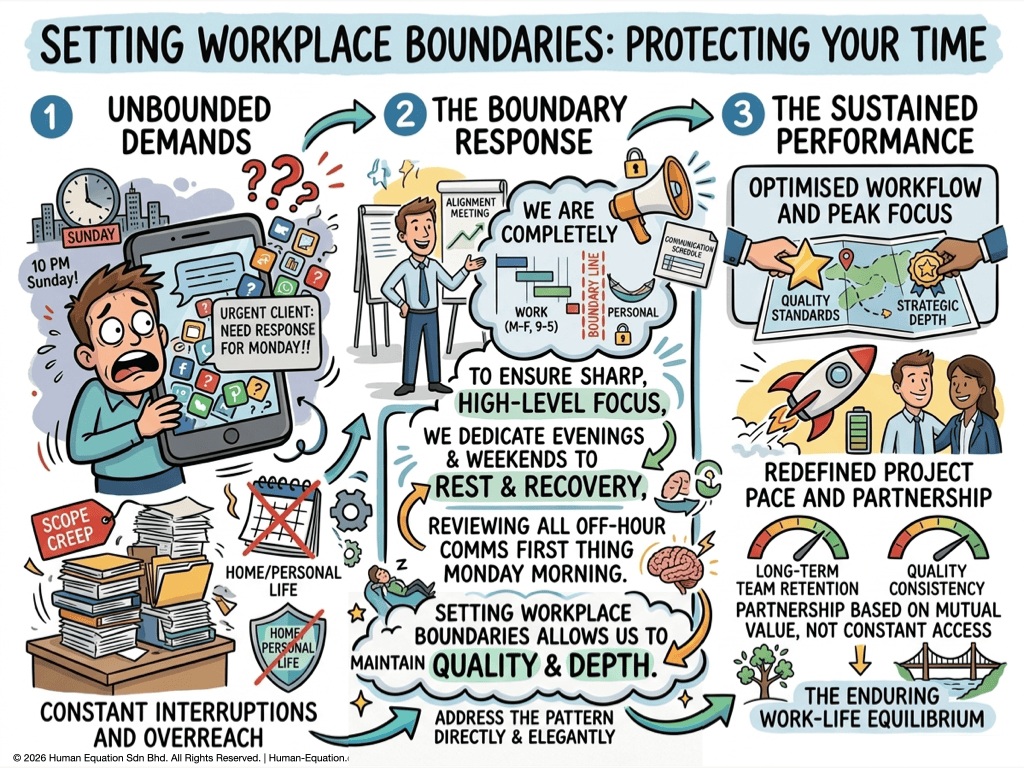
The Challenge: Imagine leading a complex regional project where a major client or senior stakeholder habitually sends non-urgent WhatsApp messages at 10:00 PM on a Sunday, expecting an immediate response before Monday morning’s board review. In many Asian corporate environments shaped by unexamined deference, the default instinct is to swallow your frustration, abandon your personal time, and comply.
The Boundary Response: Address the pattern directly and elegantly during your next alignment call:
“We are completely committed to delivering an outstanding outcome for this regional rollout. To ensure our team brings sharp, high-level strategic focus to your account, we dedicate our evenings and weekends to rest and recovery, reviewing all off-hour communications first thing on Monday morning. Moving forward, setting workplace boundaries around our core operating hours allows us to maintain the quality, rigour, and strategic depth your brand deserves.”
The Executive Outcome: The client gains immediate clarity on your operational standard, replacing unspoken resentment with mutual professional respect and setting realistic project rhythms without compromising delivery quality.
Setting Workplace Boundaries Scenario 2: Addressing Unprofessional Speech and Protecting Team Dignity
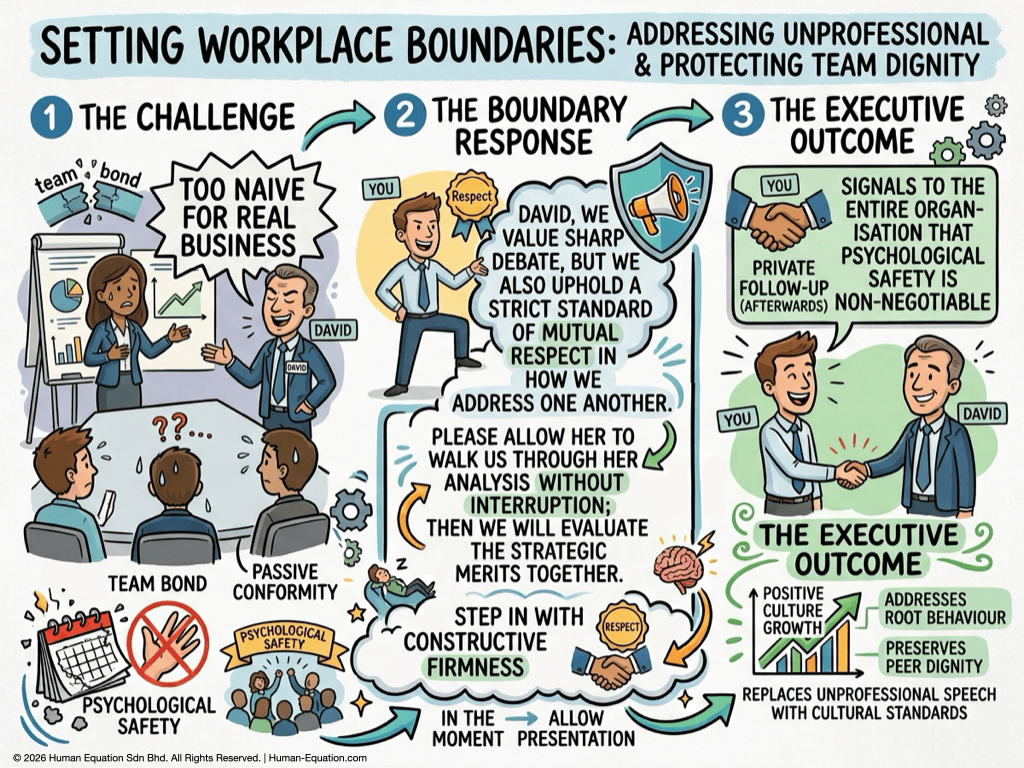
The Challenge: Picture a high-stakes strategy meeting in a corporate boardroom where a senior peer offhandedly interrupts a mid-level manager mid-presentation with a patronising remark, dismissing her regional market analysis as “too naive for real business”. The room goes quiet, caught between passive conformity and the fear of creating a scene.
The Boundary Response: Step in with constructive firmness in the moment:
“David, we value sharp debate and differing perspectives, but we also uphold a strict standard of mutual respect in how we address one another in this room. Please allow her to walk us through her analysis without interruption, and then we will evaluate the strategic merits together.”
The Executive Outcome: Intervening gracefully in real time signals to the entire organisation that psychological safety is non-negotiable. Following up with David in private afterward addresses the root behaviour constructively without publicly humiliating a peer, preserving both dignity and cultural standards.
If you or your leadership team are struggling to manage workplace expectations, overcome burnout, or build assertive communication skills, let’s connect. Reach out to our consultants at Human Equation to explore our executive coaching and organisational development programmes.
Frequently Asked Questions
How do I start setting boundaries in the workplace without appearing uncooperative?
Setting boundaries in the workplace is not about being uncooperative; it is about honesty and clear communication. Frame your boundaries around focus and value delivery. For example, rather than simply rejecting a late request, state clearly what you can accomplish within normal operating parameters and how that protects the quality of your work.
How can senior leaders handle toxic behaviour from higher authority figures?
Addressing bad behaviour from authority figures requires calling out the conduct, not the person, with grace and elegance. Use constructive, dispassionate feedback to address specific statements or actions that cross professional lines, establishing what is acceptable while maintaining emotional composure.
What is the relationship between cultural conformity and executive burnout?
Cultural conformity—such as uncritical deference to authority and fear of challenging status quotas—often leads professionals to swallow frustration and accept excessive workloads. Over time, this passive stance prevents leaders from setting essential limits on time and mental energy, leading directly to executive burnout and resentment.